
EstontincPublished 3 min read
Claude Sonnet 5.5: faster, cheaper everyday AI and what it means for your business
Anthropic’s newest Sonnet model is faster, needs fewer tokens and keeps the same price. We break down the numbers and what they mean for AI features in your product.
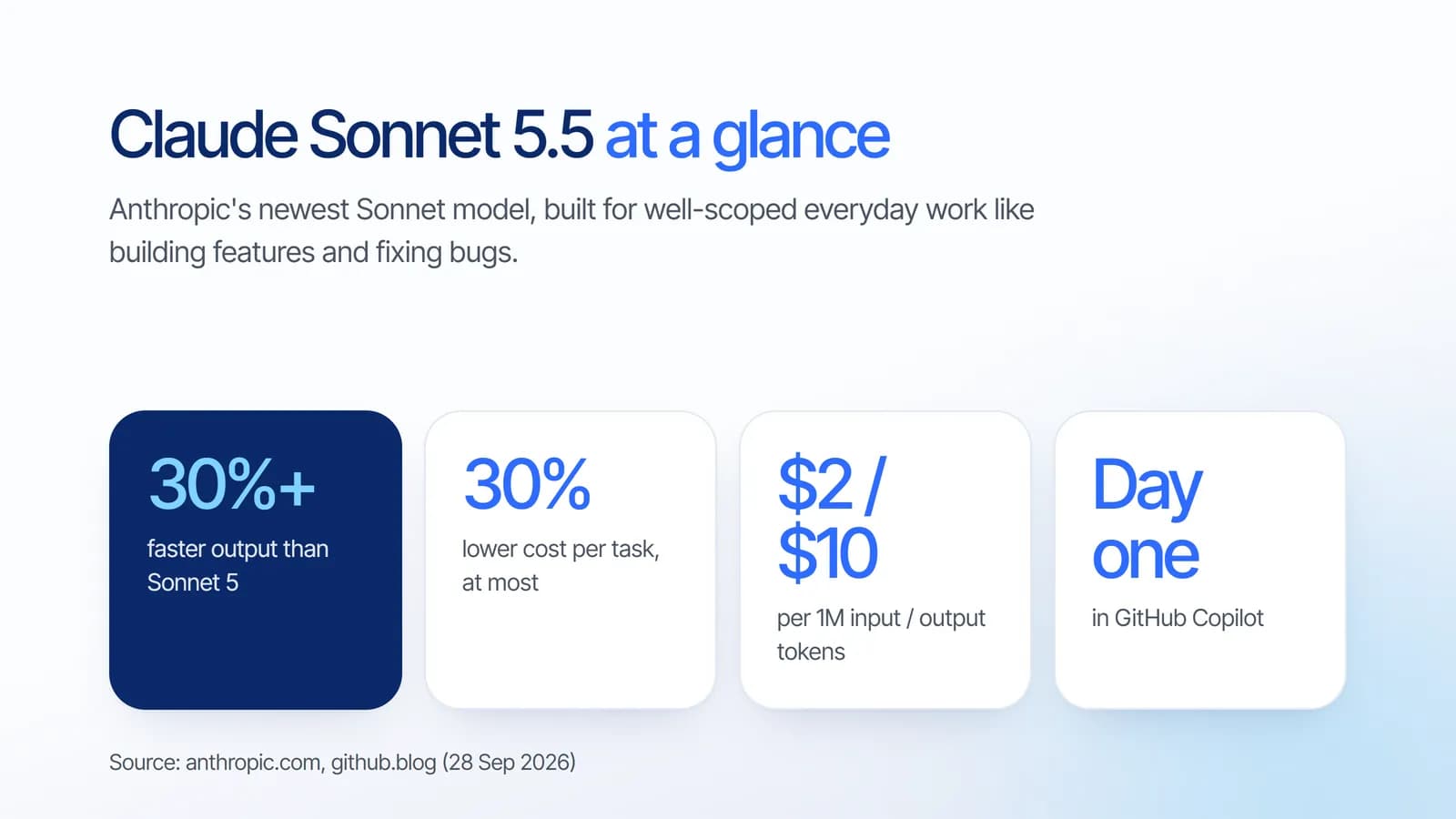
On 28 September 2026, Anthropic released Claude Sonnet 5.5, the second model in the Claude 5.5 family after Opus 5.5. Anthropic calls it “a clear upgrade over Claude Sonnet 5”: it runs more than 30% faster and costs up to 30% less for most work, at the same price.
For teams that run AI inside their products, such as chatbots, document tools or coding assistants, that combination matters. Here is what changed, based on Anthropic’s official announcement.
What’s new in Claude Sonnet 5.5
- Faster. Sonnet 5.5 generates output more than 30% faster than Sonnet 5, making it Anthropic’s fastest Sonnet model to date.
- Cheaper per task. The price stays the same, but the model typically needs far fewer tokens for the same work. In Anthropic’s testing, it costs up to 30% less per task.
- Much better at agentic coding. It scores 70.6% on Terminal-Bench 4.0, up from 10.3% for Sonnet 5.
- Clearer writing. Anthropic says it writes more clearly than the previous generation, and early testers described it as a better partner for collaboration.
- New safeguards. Its cybersecurity capabilities are comparable to Opus 5, so it is the first Sonnet model to launch with cyber safeguards. Anthropic notes that routine software development is unaffected.
Benchmarks: close to Opus 5.5 on several tests
Anthropic compared Sonnet 5.5 with Sonnet 5 and Opus 5.5 across coding, knowledge work, reasoning and computer use. On several tests, Sonnet 5.5 lands within a few points of Opus 5.5.
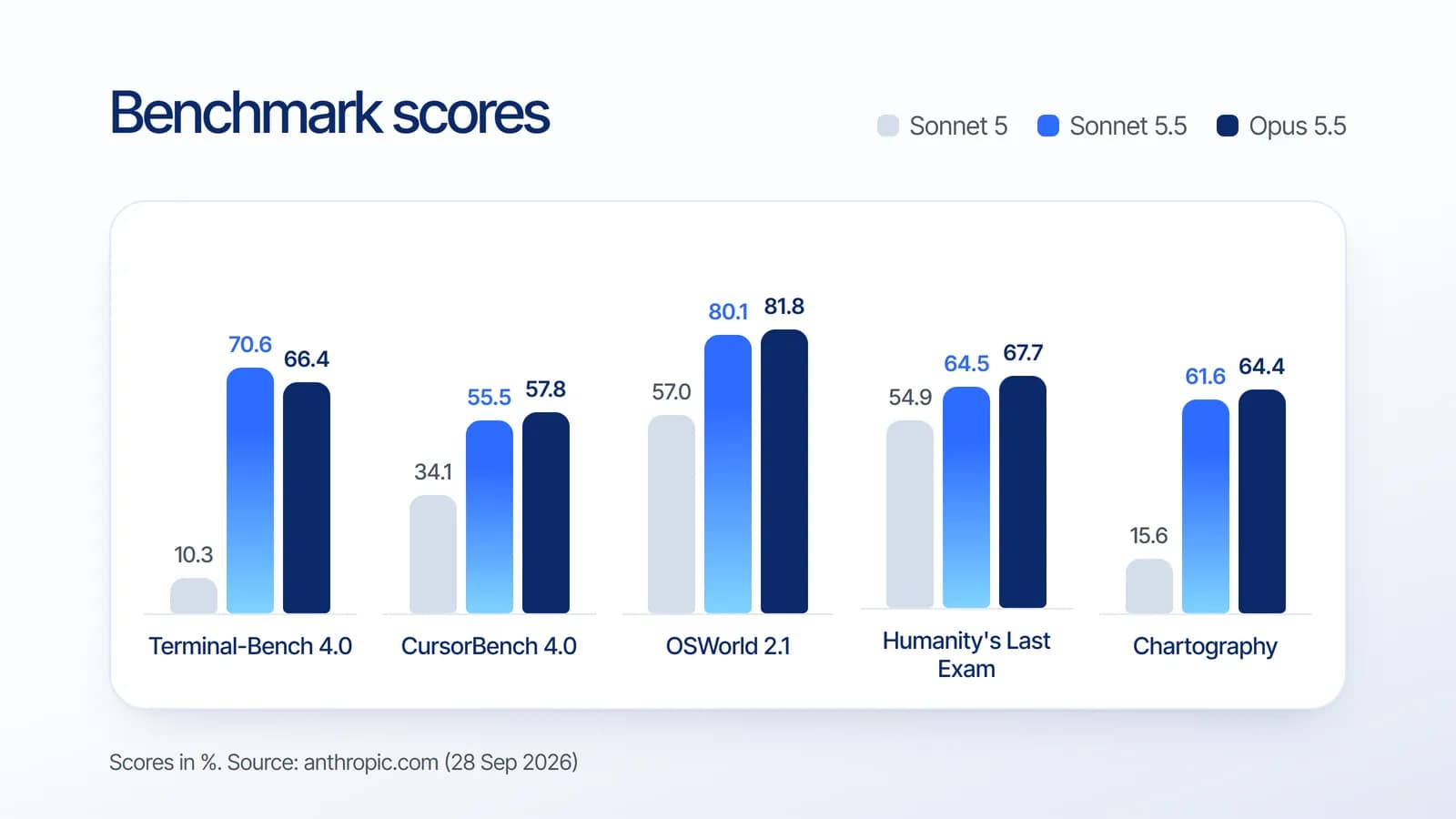
- Terminal-Bench 4.0 (agentic coding in the terminal): 70.6%, against 10.3% for Sonnet 5 and 66.4% for Opus 5.5.
- CursorBench 4.0 (multi-file tasks from real Cursor sessions): 55.5%, against 34.1% and 57.8%.
- OSWorld 2.1 (computer use): 80.1%, against 57.0% and 81.8%.
- Humanity’s Last Exam (reasoning, with tools): 64.5%, against 54.9% and 67.7%.
- Chartography (reading charts, no tools): 61.6%, against 15.6% and 64.4%.
Anthropic is also clear about the limits: benchmark scores capture only one facet of a model, and in its own testing Opus 5.5 remains clearly stronger at complex, open-ended work that needs sustained judgment.
Pricing: same rates, fewer tokens
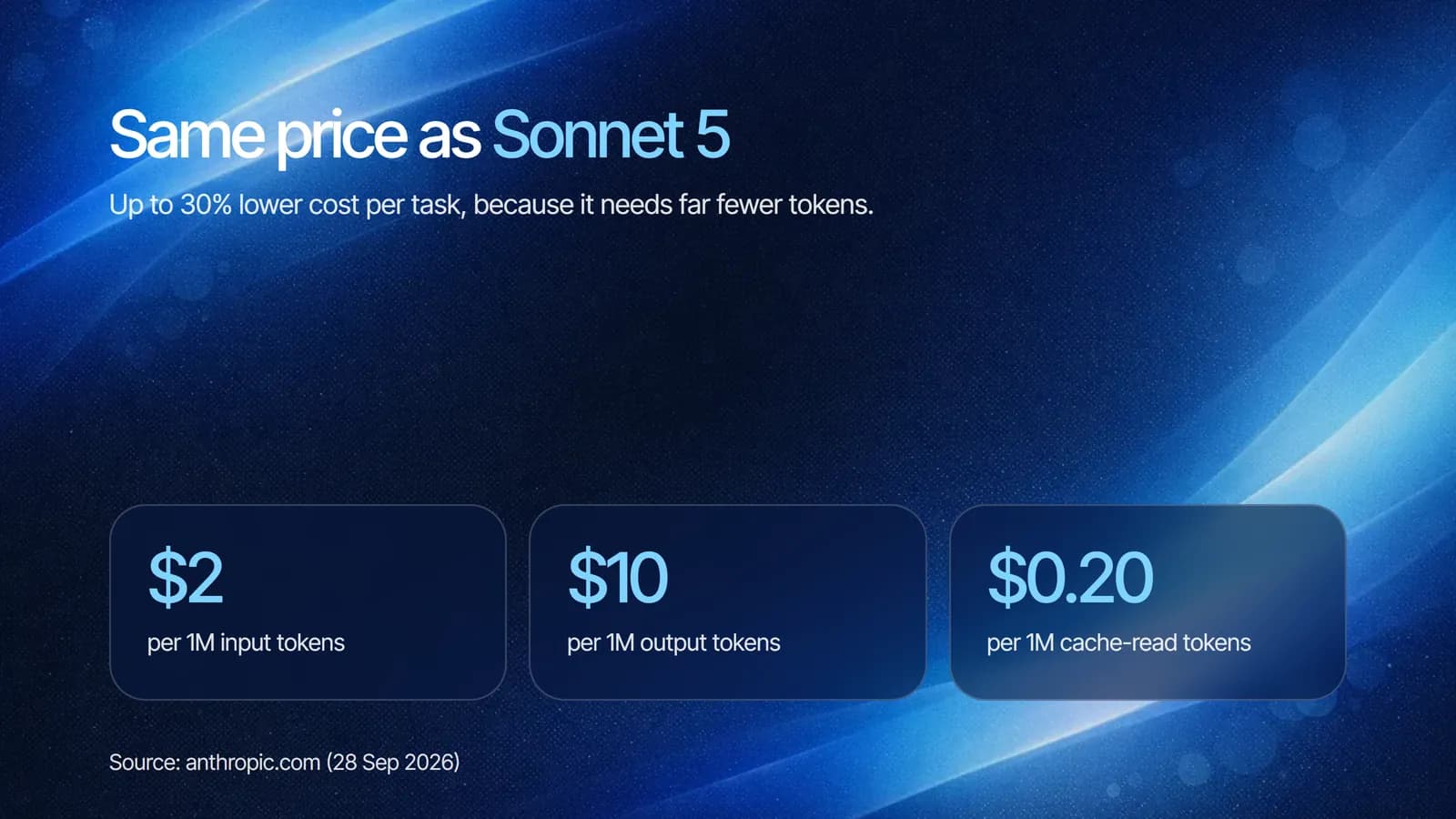
Sonnet 5.5 costs the same as Sonnet 5: $2 per million input tokens, $10 per million output tokens and $0.20 per million tokens for cache reads. The saving comes from efficiency. On Terminal-Bench 4.0, Anthropic reports that Sonnet 5.5 at Medium effort, the default in the Claude apps, far exceeds Sonnet 5’s best score for less than a tenth of the cost per task.
Sonnet, Opus or Haiku: which model fits which job
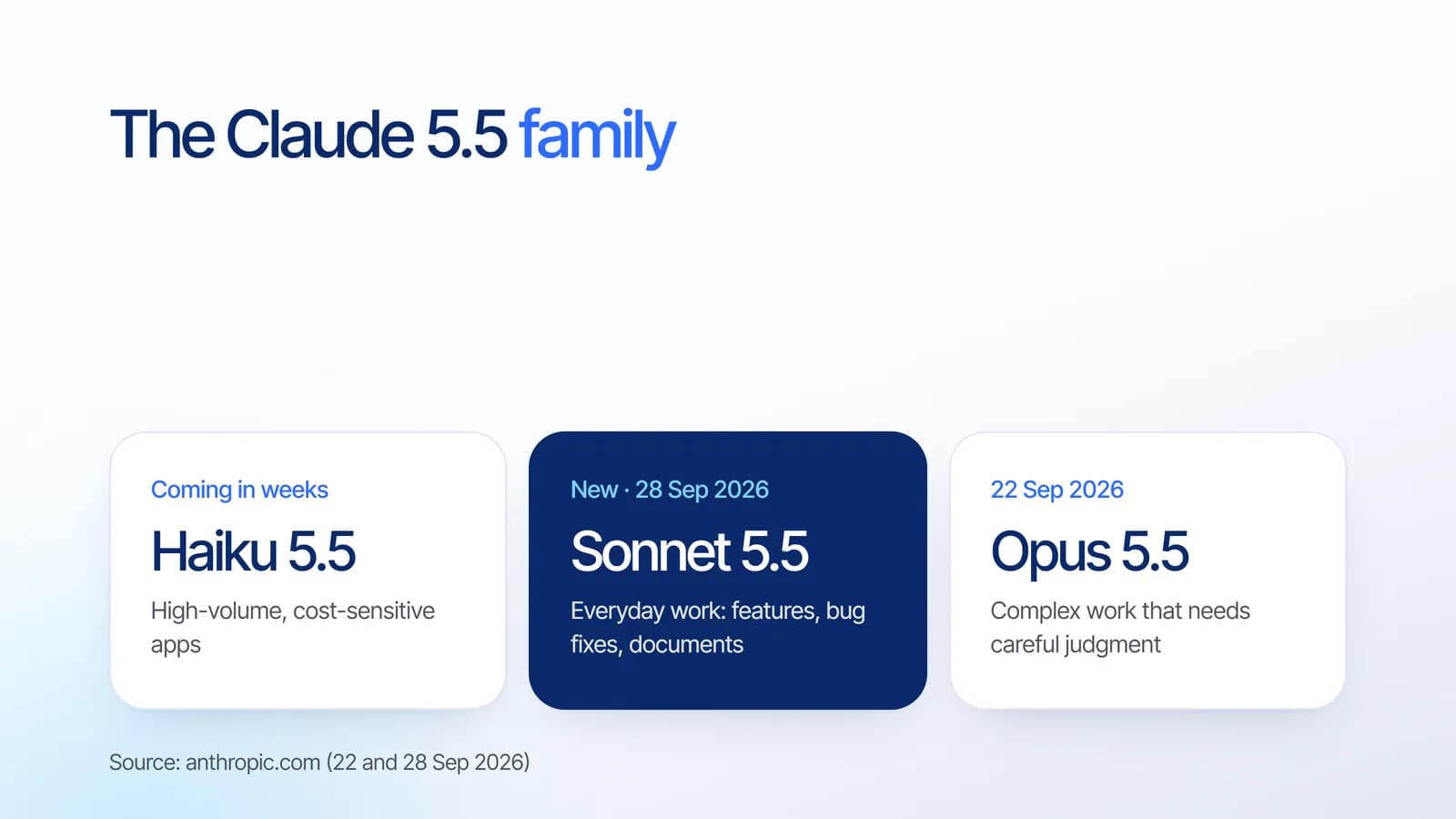
- Sonnet 5.5 is strongest at well-scoped everyday tasks: building features, fixing bugs, and creating polished documents, slides and spreadsheets.
- Opus 5.5 is built for complex work that requires careful judgment.
- Haiku 5.5, built for high-volume and cost-sensitive applications, will join the Claude 5.5 family in the coming weeks.
Sonnet 5.5 is also available in GitHub Copilot for Pro, Pro+, Max, Business and Enterprise users, with a gradual rollout that started on 28 September.
What it means for your business
If your product already runs on Claude, the same AI features can now respond faster and cost less per task. If you are still planning an AI feature, the bar for cost and speed just moved in your favor. Our guide to app development cost explains how to budget for AI features and their running costs.
The practical question is no longer whether to use AI, but which model fits each job. Three things we recommend:
- Match the model to the task. Use a fast, efficient model like Sonnet for everyday requests, and keep a stronger model like Opus for the few cases that need deep reasoning.
- Measure before you switch. Test the new model on your own prompts and data, and compare quality, speed and cost per task.
- Keep costs predictable. Track token usage per feature, so a busy month does not surprise you on the invoice.
How Estontinc can help
Estontinc is a software house from Malang, Indonesia. Through our AI development service, we add AI to web and mobile apps, from chatbots and document summaries to workflow automation, and keep them running after launch with monitoring and maintenance. You get weekly demos, and you own the source code.
Have an AI feature in mind? Tell us about it and we will reply within 24 hours with a plan, timeline and estimate.
Frequently asked questions
What is Claude Sonnet 5.5?
Claude Sonnet 5.5 is Anthropic’s newest Sonnet model, released on 28 September 2026 as the second model in the Claude 5.5 family. Anthropic says it runs more than 30% faster than Sonnet 5 and costs up to 30% less per task for most work, at the same price.
How much does Claude Sonnet 5.5 cost?
Sonnet 5.5 is priced the same as Sonnet 5: $2 per million input tokens, $10 per million output tokens and $0.20 per million tokens for cache reads. Because it typically needs fewer tokens for the same work, Anthropic reports up to 30% lower cost per task.
Should I use Claude Sonnet 5.5 or Opus 5.5?
Anthropic positions Sonnet 5.5 for well-scoped everyday tasks such as building features, fixing bugs and creating documents, and Opus 5.5 for complex, open-ended work that needs careful judgment. Many products use a fast model for most requests and a stronger one for the hardest cases.
Sources
Facts and figures in this article come from these official sources.
- AI
- AI development
- Claude
- LLM
- AI integration