
EstontincPublished 3 min read
How to choose the right AI model for your business, and what Claude Haiku 5.5 changes
Claude Haiku 5.5 costs around 75% less to run than Haiku 4.5. How to match small, mid and large AI models to the right tasks, and keep costs under control as usage grows.

Knowing how to choose the right AI model has become one of the most practical decisions in any AI project. On 7 October 2026, Anthropic released Claude Haiku 5.5, which it describes as its cheapest, fastest and most capable small model. It costs around 75% less to run than Haiku 4.5 on average, which changes the maths for many everyday business tasks.
The lesson is broader than one model. Most AI costs come from many small, repetitive requests, and those rarely need the most powerful model. This guide explains what Anthropic announced, how to match model size to each task, and how to keep costs under control.
What Anthropic announced
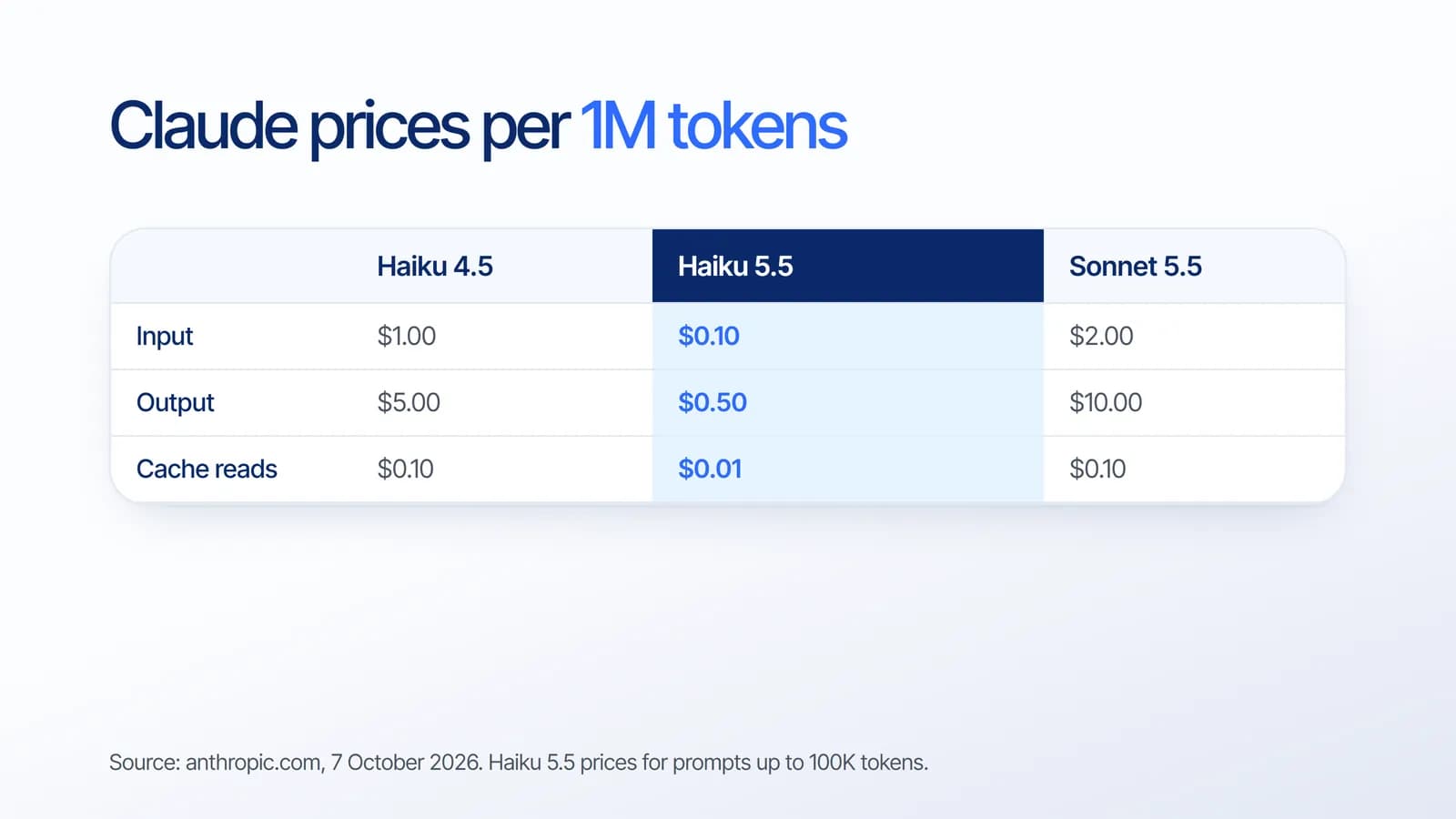
- Price. Haiku 5.5 costs $0.10 per million input tokens and $0.50 per million output tokens for prompts up to 100,000 tokens, which Anthropic says covered around 90% of requests to Haiku 4.5.
- Speed. It is Anthropic’s fastest model to date at standard speed.
- Effort setting. It is the first Haiku-class model with an adjustable effort setting, so you can choose between lower cost and more intelligence.
- Sonnet 5.5 is cheaper too. Cache reads on Sonnet 5.5 now cost 50% less, which Anthropic says reduces its cost on most agentic tasks by around 20%.
- Availability. Haiku 5.5 is available on the Claude Platform as claude-haiku-5-5 and on Amazon Web Services, Google Cloud and Microsoft Azure.
Small, mid, or large: match the model to the task
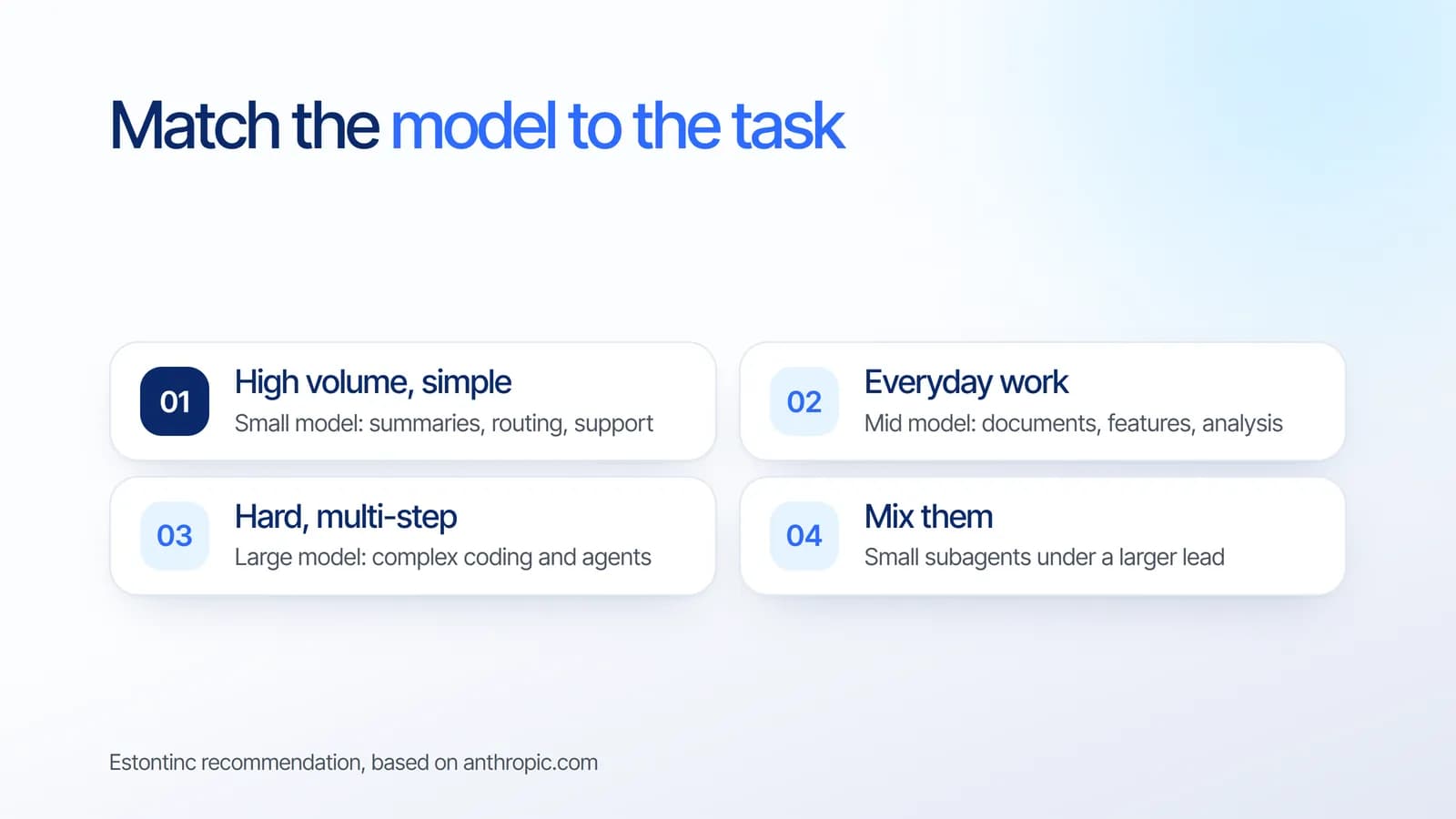
Anthropic positions Haiku 5.5 for high-volume, cost-sensitive work such as summaries, classification and database queries, and for speed-sensitive tasks like live customer support. It also states that Sonnet 5.5 and Opus 5.5 remain better choices for complex agentic coding. Based on our project experience, this is how we would map tasks to model size:
- Small model: routing messages, tagging tickets, short summaries, extracting fields from documents, first-line chatbot answers.
- Mid model: writing and reviewing documents, building features, analysis that needs some judgement.
- Large model: long, multi-step agent work and complex coding where mistakes are expensive.
- A mix: a larger model leads the task while small models handle quick lookups as subagents. Anthropic describes Haiku 5.5 as pairing well with Opus 5.5 and Sonnet 5.5 in exactly this role.
Why the cheapest model is not always the cheapest choice
A small model that gets an answer wrong can cost more than a larger model that gets it right, once you count rework, unhappy customers or a human checking every output. That is why we test on real examples before choosing. Start with the small model, measure quality, and move up only for the tasks where it falls short.
The adjustable effort setting helps here too: the same model can spend less effort on easy requests and more on harder ones, so you are not forced to switch models for every change in difficulty.
How to keep AI costs under control
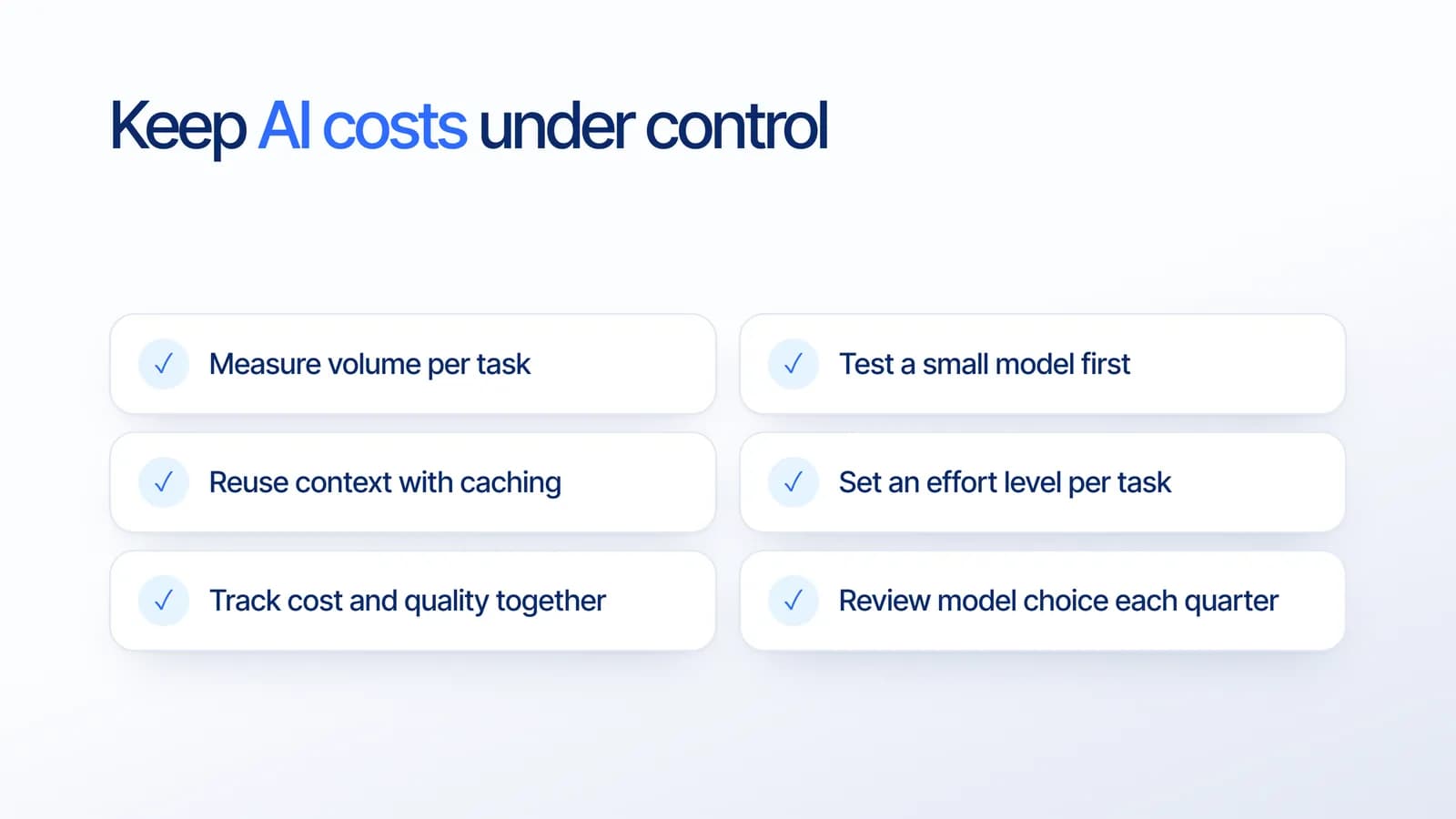
- Measure volume per task. The tasks that run thousands of times a day are where model choice matters most.
- Test a small model first on real examples before defaulting to a larger one.
- Reuse context with caching. Cache reads are much cheaper than fresh input on every Claude model listed above.
- Set an effort level per task instead of using the maximum everywhere.
- Track cost and quality together, so savings do not quietly turn into worse answers.
- Review your model choice each quarter. Prices and capabilities change often, as this release shows.
For a broader view of how AI changes team planning, see our article on the AI talent gap. If your AI needs to work with old desktop software, automating legacy software with AI covers the options.
What it means for your business
Cheaper small models make AI practical for work that runs all day: answering routine customer questions, sorting incoming requests, summarising documents. We suggest designing AI features so each task can use a different model, rather than locking the whole product to one. That way you can take advantage of price drops like this one without rebuilding anything.
How Estontinc helps
Estontinc is a software house in Malang with 100+ projects and 50+ clients over more than six years. Through our AI development service we design AI features that route each task to the right model and track cost and quality together. Our custom software and API team connects those features to your existing systems and data.
You see progress in weekly demos and the source code is yours. Tell us which process you want AI to help with through the contact page, and we will reply within 24 hours.
Frequently asked questions
How do I choose the right AI model for my business?
Match model size to the task. Use small models for high-volume, simple work like summaries and routing, mid-size models for everyday work, and large models for complex multi-step tasks. Test on real examples, start small, and move up only where quality falls short.
What is Claude Haiku 5.5?
Claude Haiku 5.5 is Anthropic’s small model released on 7 October 2026. Anthropic calls it its cheapest, fastest and most capable small model, costing around 75% less to run than Haiku 4.5 on average, with input at $0.10 and output at $0.50 per million tokens for prompts up to 100,000 tokens.
When should I use a small AI model instead of a large one?
Use a small model for quick, repetitive tasks such as summaries, classification, database queries and live customer support. Anthropic recommends larger models like Sonnet 5.5 or Opus 5.5 for complex agentic coding. Many teams combine them, with small models working as subagents under a larger one.
How can I reduce AI costs?
Measure which tasks run most often, test a smaller model first, reuse context with prompt caching, set an effort level per task, and track cost alongside quality. Review your model choice regularly, since prices and capabilities change often, as the Haiku 5.5 release showed.
Sources
Facts and figures in this article come from these official sources.
- AI
- Claude
- Automation
- Custom software