EstontincPublished 4 min read
App development cost: 7 factors that decide the price (and how to get an accurate estimate)
Why two app quotes can differ so much, the seven factors that really drive the price, and how to prepare a brief that gets you an accurate estimate.
The honest answer to “how much does it cost to build an app?” is: it depends on what the app needs to do. App development cost is driven by a handful of clear factors, such as the platforms you target, the number of features, the design, the integrations and what happens after launch. Once you understand them, you can compare quotes fairly and control your budget.
This guide walks through the seven factors that decide the price, the two common pricing models, the official app store fees, and how to get an estimate you can trust. We will not quote a generic price range, because a number without a scope is not useful. Instead, we show you what to decide so a quote becomes precise.
7 factors that decide app development cost
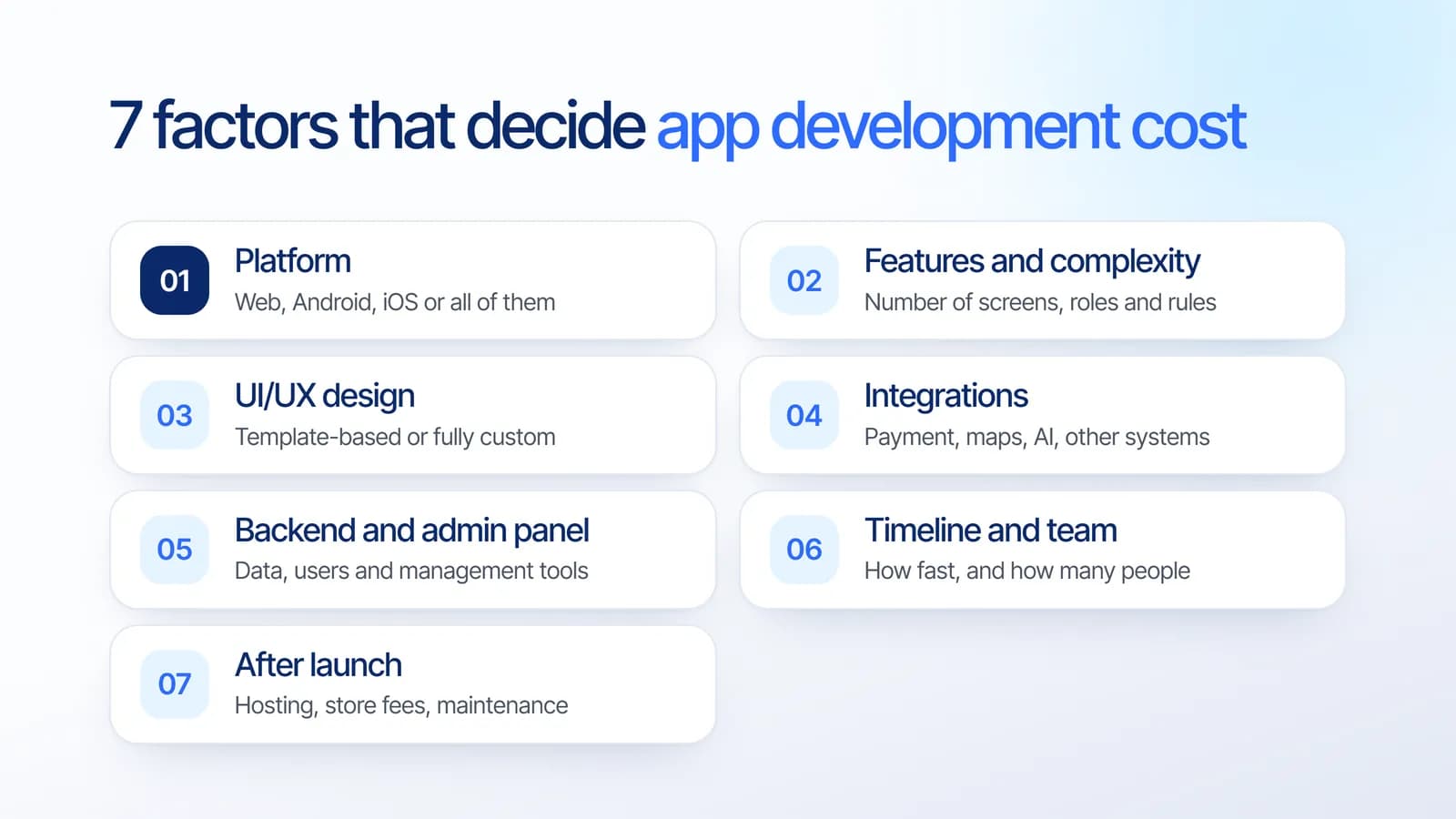
1. Platform: web, Android, iOS or all three
A web app runs in the browser on any device. A mobile app lives in the app stores and can use phone features like the camera and push notifications. Building for Android and iOS at once with a cross-platform framework often costs less than two separate native apps. If you are unsure which you need, read web app vs website vs mobile app.
2. Features and complexity
This is the biggest factor. Count the screens, user roles (customer, admin, driver) and business rules. A simple booking flow is very different from real-time tracking, chat or complex approvals. Every feature needs design, development and testing.
3. UI/UX design
A design built on a proven component library is faster than a fully custom visual identity with animations. Good UI/UX design is not decoration: it reduces support requests and makes users stay, so it is worth investing where users spend the most time.
4. Integrations
Payment gateways, maps, messaging, accounting software or AI models all add work: setup, error handling and testing. Integrations with older internal systems usually take the most time, because their documentation is often incomplete.
5. Backend and admin panel
Most apps need a server, a database and an admin panel to manage users, content and orders. The admin side is easy to forget in a brief, but it is often a large part of the work.
6. Timeline and team
A tighter deadline needs more people working in parallel, which adds coordination. A realistic timeline with weekly demos usually gives the best balance of speed, quality and cost.
7. Costs after launch
Budget for hosting, domains, third-party services, app store accounts and maintenance: bug fixes, security updates and small improvements. An app that is not maintained slowly breaks as phones, browsers and frameworks change.
Fixed price vs time and materials
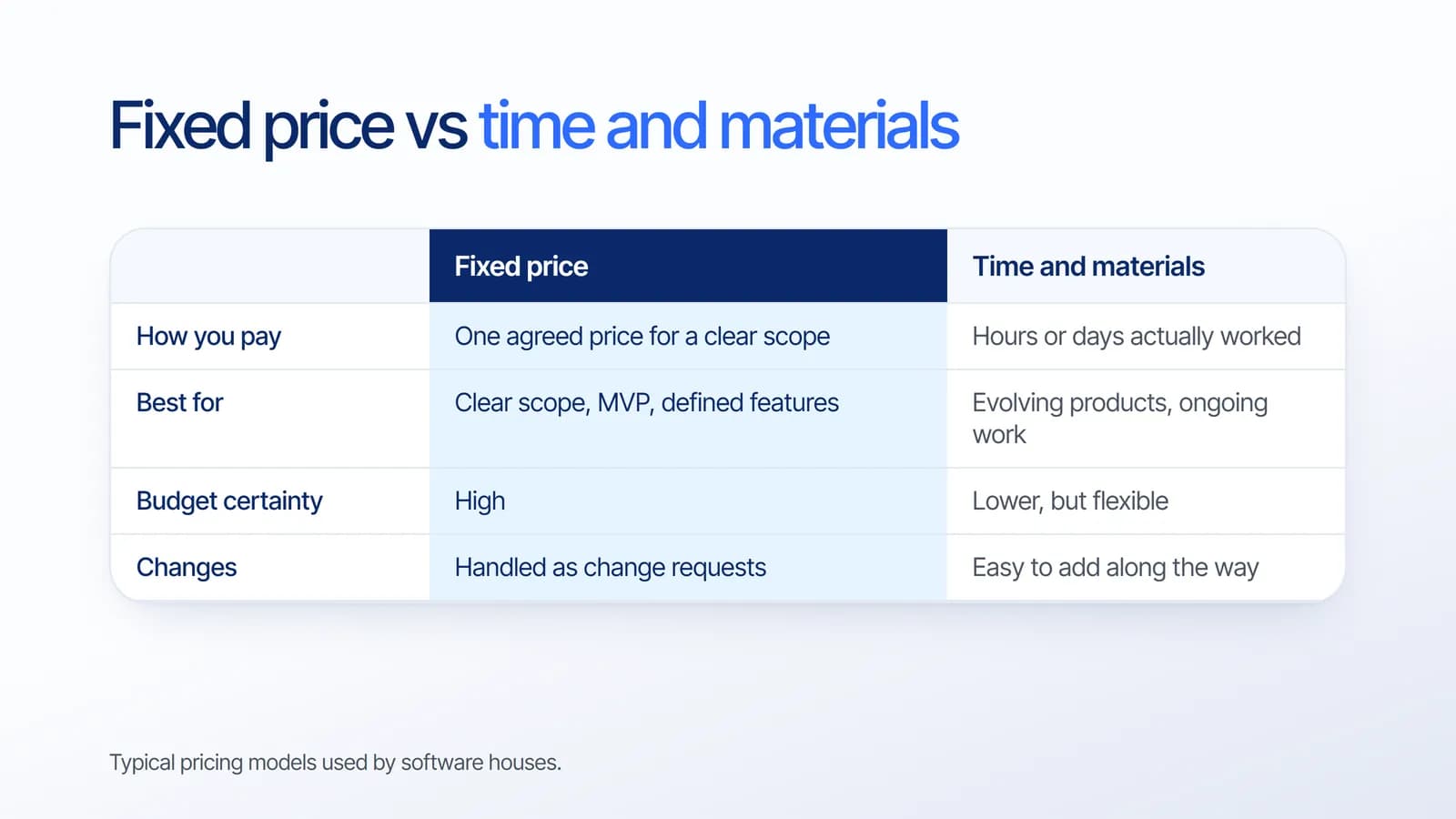
With a fixed price, you agree on a clear scope and one price. It gives budget certainty and suits an MVP or a well-defined set of features. Changes are handled as change requests. With time and materials, you pay for the hours or days actually worked. It is more flexible for products that evolve every week, but the final total is less predictable.
Official app store fees
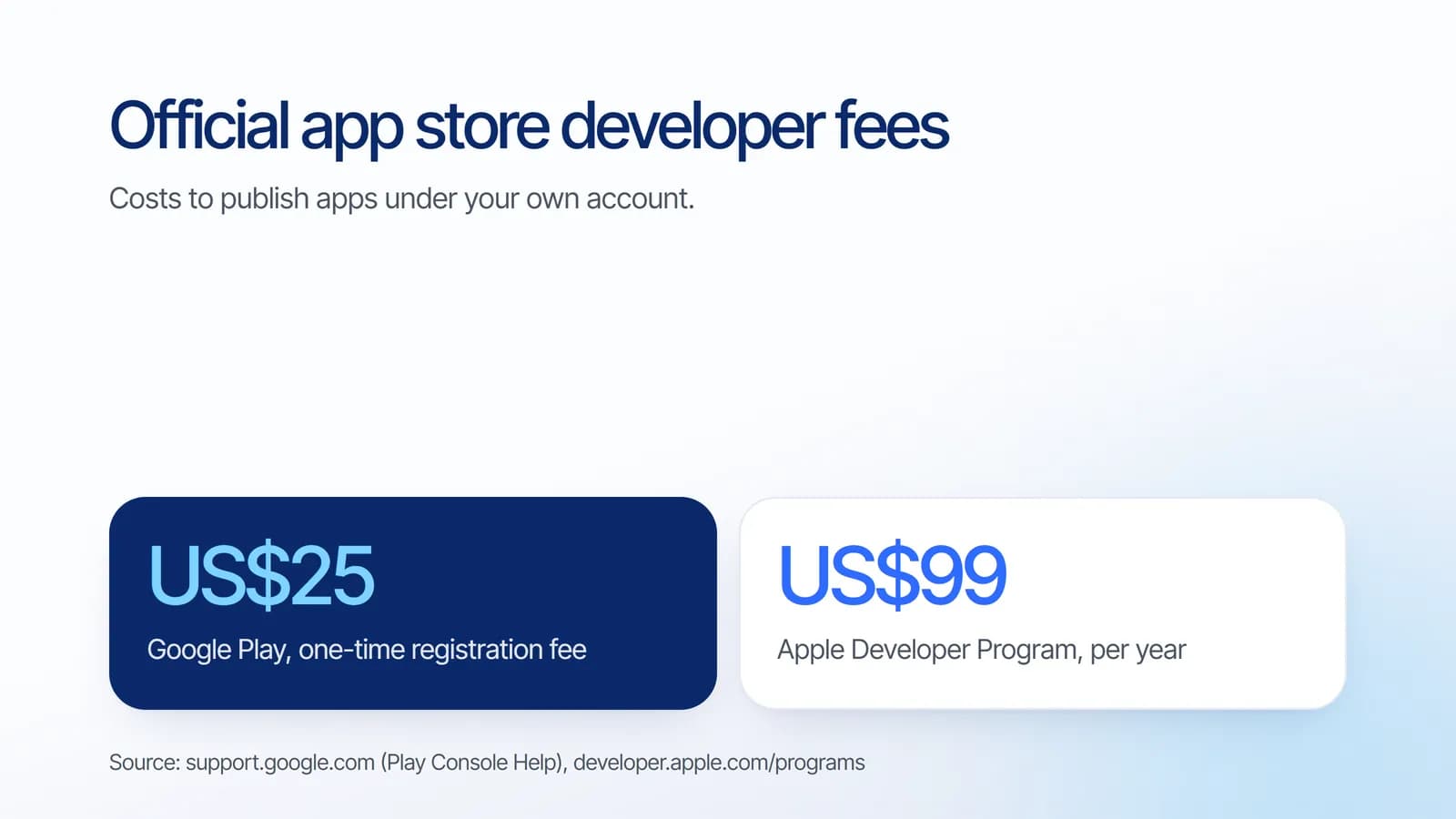
To publish under your own account, Google Play charges a US$25 one-time registration fee, and the Apple Developer Program costs US$99 per year. We recommend that apps are published under the client’s own accounts, so you keep full control of your listing.
How to get an accurate estimate
- Describe the problem, not only the features. Who are the users, and what should they be able to do on day one?
- Split must-haves from nice-to-haves. Launching a focused first version is the fastest way to lower cost. Our MVP development guide shows how.
- List integrations and existing systems. Mention payment, login methods and any system the app must talk to.
- Share examples. Apps you like, or dislike, save hours of back-and-forth.
- Ask what is included. Design, testing, deployment, store submission and post-launch support should be clearly stated.
Why quotes differ so much
Two quotes for “the same app” often assume different scopes: one includes the admin panel, testing and support, the other does not. Always compare what is included line by line, not only the total. A clear breakdown is a sign of a partner that has thought your project through.
How Estontinc estimates your project
We start with a free consultation to understand your goals, then reply within 24 hours with a plan, timeline and estimate. For fixed-price projects, you get free support for 30 days after launch, and you own the source code from day one. Whether you need a mobile app, a web application or custom software, we can help you decide what to build first.
Ready to see what your app would take? Request a free estimate.
Frequently asked questions
How much does it cost to build an app?
It depends on the platforms, the number and complexity of features, the design, the integrations, the backend and admin panel, the timeline and the costs after launch. A reliable price needs a defined scope, so start with a clear brief and ask for an itemized estimate.
Is it cheaper to build a web app or a mobile app?
A web app is often cheaper to start, because one version runs on every device through the browser. A mobile app makes sense when you need app store presence or phone features. Building Android and iOS with one cross-platform codebase can reduce the cost of a mobile app.
What are the fees to publish on Google Play and the App Store?
Google Play charges a US$25 one-time registration fee for a developer account. The Apple Developer Program costs US$99 per year. These are fees for your own publishing accounts and are separate from the cost of building the app.
Should I choose fixed price or time and materials?
Choose fixed price when the scope is clear, for example an MVP with defined features, and you want budget certainty. Choose time and materials when the product will change often and you prefer flexibility over a fixed total.
Sources
Facts and figures in this article come from these official sources.
- Guide
- Mobile apps
- Web development
- Custom software
- App cost