
EstontincPublished 4 min read
The AI talent gap: should your business hire, train, or partner to build with AI?
Anthropic’s new $100 million academy shows how scarce hands-on AI engineers are. What that means for mid-sized businesses, and how to choose between hiring, training, and partnering.
The AI talent gap has become one of the biggest obstacles to using AI in business. On 2 October 2026, Anthropic launched Claude Frontier Academy, a $100 million commitment to train 10,000 Frontier Deployed Engineers by the end of 2027. In Anthropic’s words, the people with the skills to make AI work inside a real business “have become the hardest talent to find.”
If large consulting firms and banks are sending their strongest engineers to train, most mid-sized companies will not build this capability overnight. This article explains what Anthropic announced, why it matters, and how we suggest choosing between hiring, training, and partnering.
What Anthropic announced
Claude Frontier Academy is Anthropic’s program to train engineers who can take Claude from an idea to a system in production. According to the announcement:
- $100 million is committed to train 10,000 Frontier Deployed Engineers by the end of 2027.
- The first cohorts include engineers from Accenture, Bain, Capgemini, Commonwealth Bank of Australia, Deloitte, McKinsey, Morgan Stanley and Novo Nordisk.
- Cohorts run in San Francisco, New York and London, and participation is by nomination.
- The program is for hands-on software engineers with strong fundamentals and a record of building with LLMs. Prior experience building AI agents is not required.
How the program works
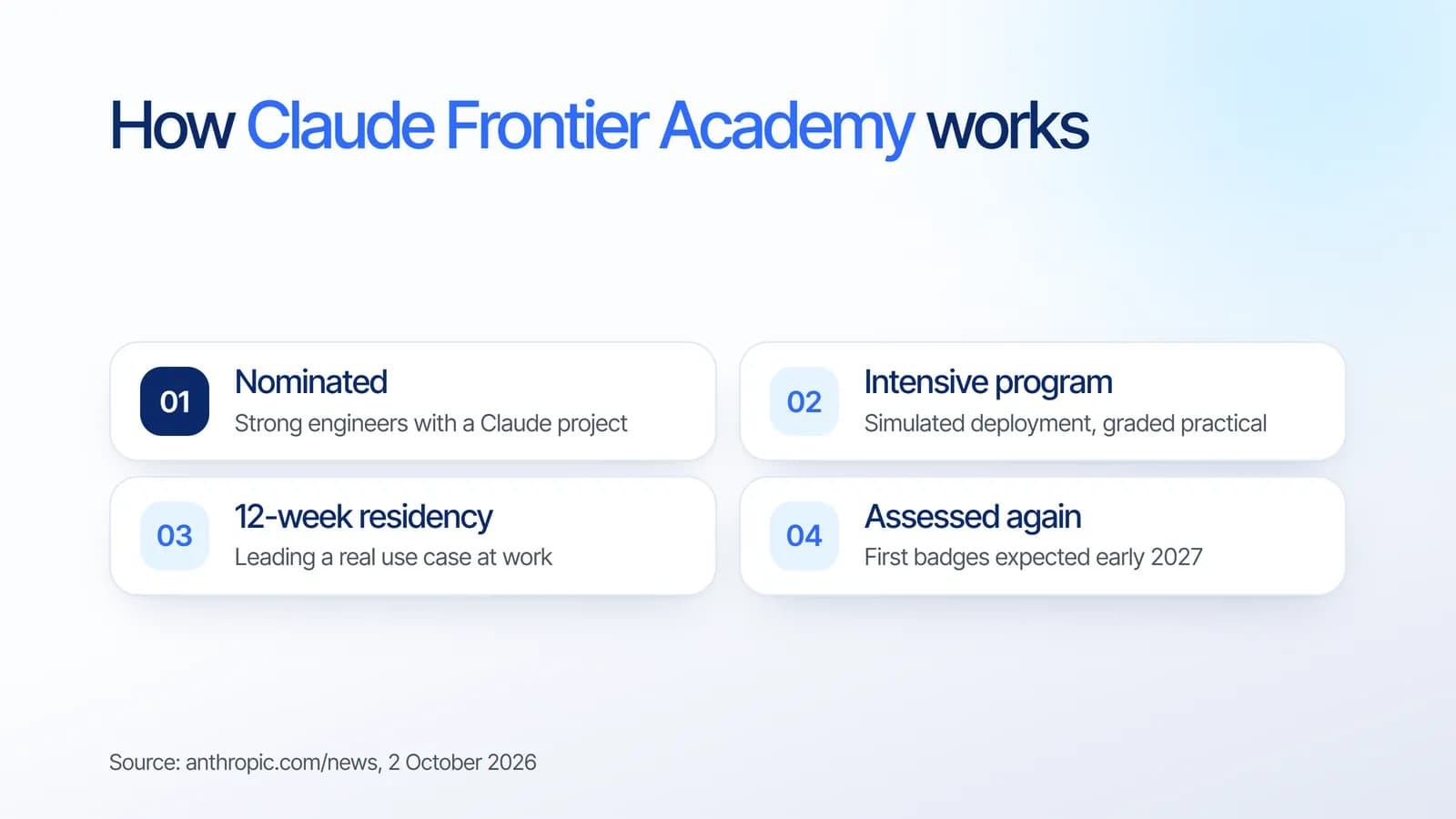
- Nomination. Organizations nominate their strongest engineers, each arriving with a named Claude project to lead.
- Intensive program. A multi-day, in-person program with Anthropic engineers, working through a simulated enterprise deployment from use case to security review to handover, then a graded practical.
- 12-week residency. Engineers who pass lead a real Claude use case at their own organization, supported by Anthropic engineers.
- Assessment. Those who pass earn the Claude Frontier Deployed Engineer badge, with the first expected in early 2027.
A small team of high-agency people with the right skills, access to Claude, and a deep understanding of how their business runs can transform an entire company.
Why the AI talent gap matters for your business
The interesting part of this announcement is not the model, it is the people. Anthropic says that inside the companies it works with, a small group of deeply skilled people drives an outsized share of what AI delivers. The skill in demand is not prompting. It is taking AI all the way into production: choosing the right use case, connecting it to real data, passing security review, and handing it over.
For a mid-sized company, that combination of AI fluency and software engineering is hard to hire and slow to grow. Waiting until you have it in-house can mean watching competitors move first.
Hire, train, or partner: how to choose
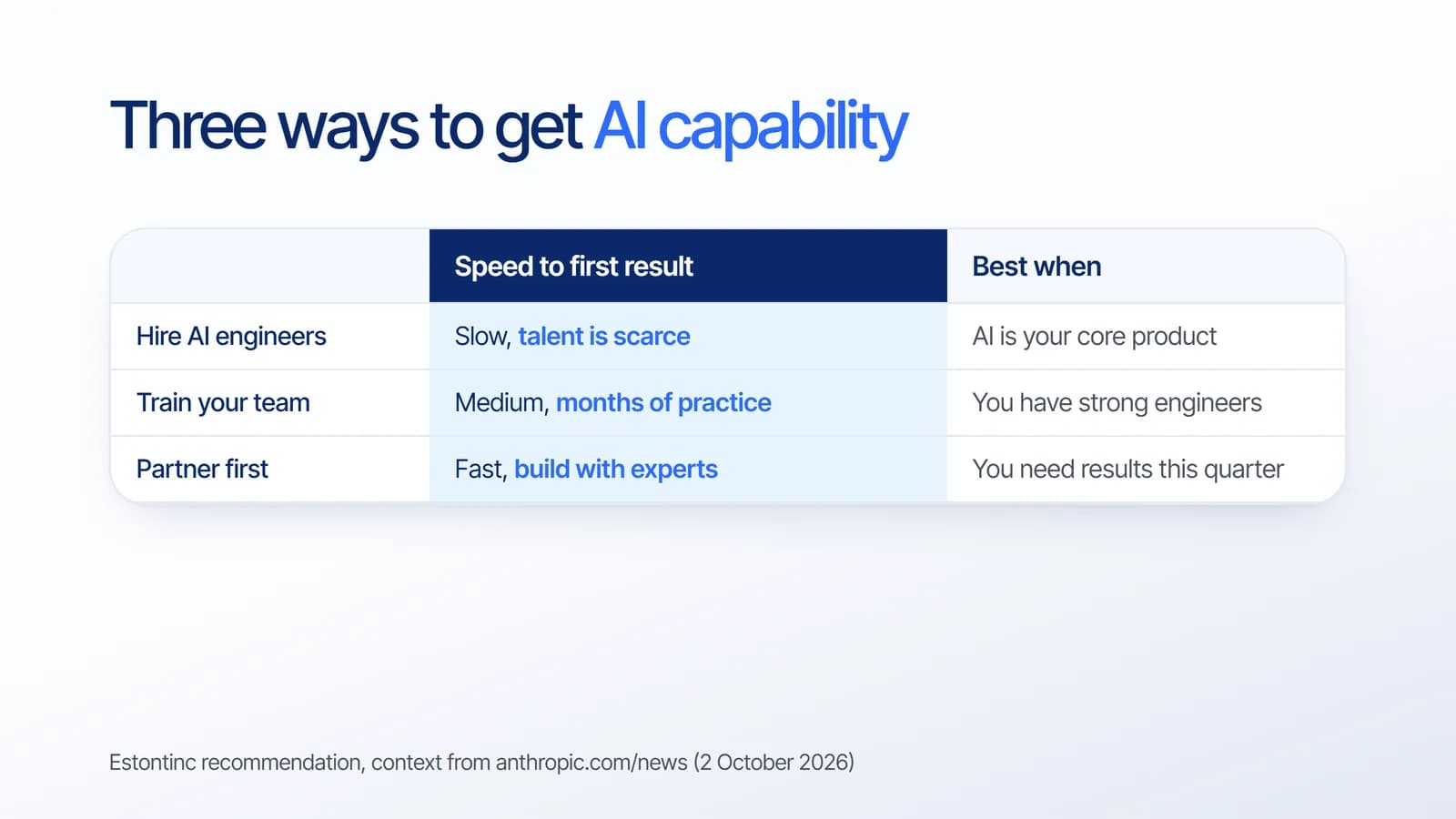
Based on our project experience, this is how we would think about the three options:
- Hire AI engineers when AI is your core product and you need the capability permanently. Expect a long search, since this is exactly the talent Anthropic describes as hardest to find.
- Train your existing team when you already have strong software engineers. It builds lasting capability, but it takes months of practice on real projects, as the 12-week residency model shows.
- Partner first when you need results this quarter. A team that has already shipped AI into production builds the first system with you, then hands it over so your people learn on something real.
These options are not exclusive. Many companies partner for the first project and train their own engineers alongside it. That is also why we recommend starting small, as described in our MVP development guide.
Before your first AI project
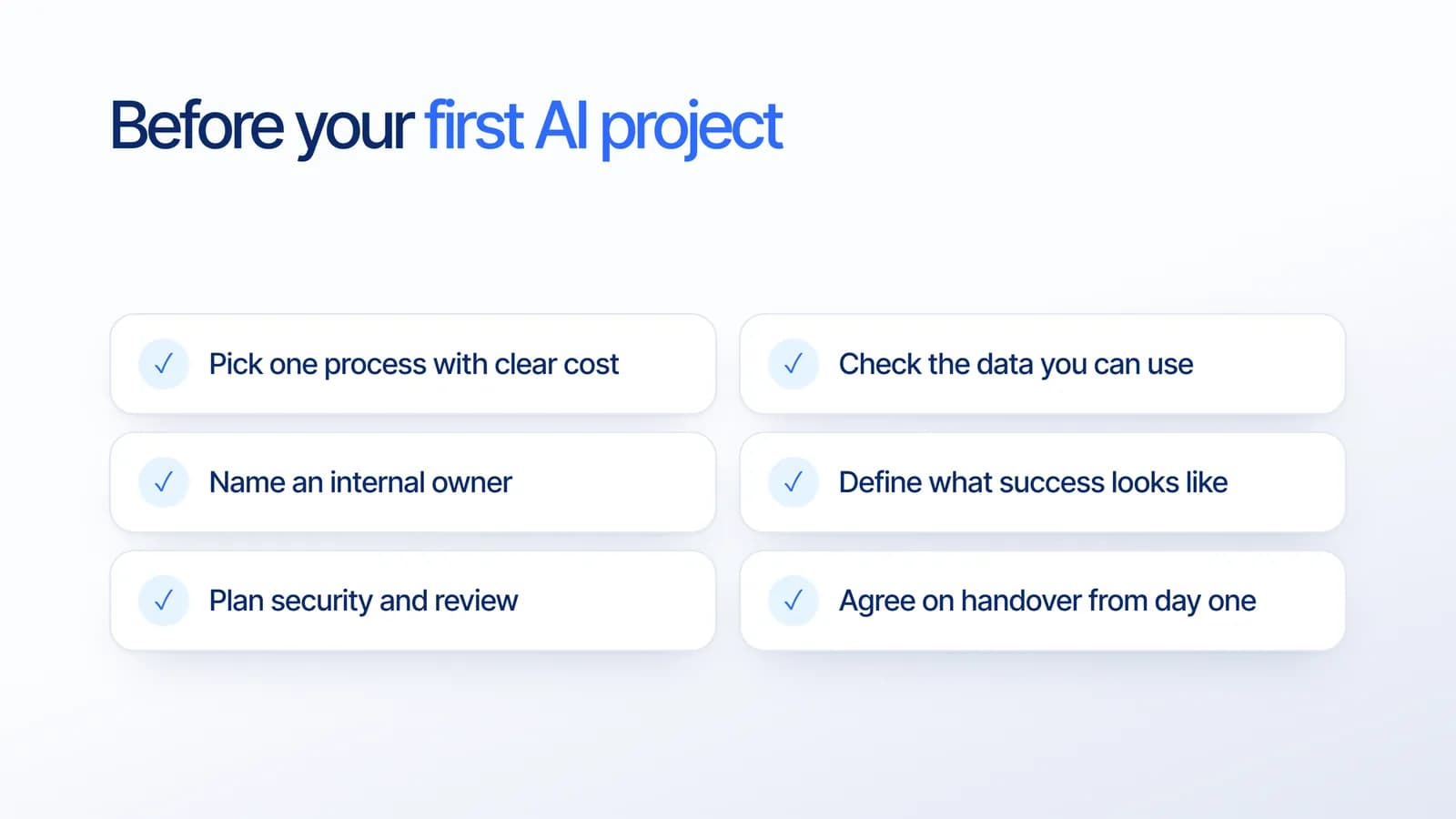
- Pick one process with a clear cost. Hours spent, errors made, or customers waiting.
- Check the data you can use. AI is only as useful as the information it can reach safely.
- Name an internal owner. Someone who understands how the business runs, as Anthropic’s own model emphasizes.
- Define what success looks like. Time saved, faster responses, fewer errors.
- Plan security and review. Decide what the AI can access and which actions need a human to approve.
- Agree on handover from day one. Documentation, source code, and training for your team.
If part of the process runs on old desktop software, our article on automating legacy software with AI covers the options there.
What it means for your business
When an AI company invests $100 million in training people rather than only improving models, it is a signal that the bottleneck has moved. Access to capable AI is no longer the hard part. Turning it into processes that actually run every day is. We suggest planning AI work around that bottleneck: decide who will own it, and how your team will learn from the first project.
How Estontinc helps
Estontinc is a software house in Malang with 100+ projects and 50+ clients over more than six years. Through our AI development service we help you pick the right use case and build it to production, not just a prototype. Our custom software and API team connects AI to your existing systems and data.
We run weekly demos, work under NDA, and the source code is yours, so the knowledge stays with your team. Tell us which process you want AI to help with through the contact page, and we will reply within 24 hours.
Frequently asked questions
What is the AI talent gap?
It is the shortage of people who can take AI from an idea to a system that runs in a real business. Anthropic describes them as the hardest talent to find, and on 2 October 2026 committed $100 million to train 10,000 Frontier Deployed Engineers by the end of 2027.
What is Claude Frontier Academy?
It is Anthropic’s program to train Frontier Deployed Engineers. Nominated engineers complete an intensive in-person program and a graded practical, then a 12-week residency leading a real Claude use case at their own organization. The first badges are expected in early 2027.
Should my company hire AI engineers or work with a partner?
Hire when AI is your core product and you need the skill permanently. Train your team when you already have strong engineers and time to practice. Work with a partner when you need results soon, ideally one that hands over the source code so your team learns from the first project.
How do I start an AI project without an in-house AI team?
Start with one process that has a clear cost, check which data the AI can use safely, name an internal owner, and define success. Then build a small first version with an experienced partner and agree on documentation and handover from the beginning.
Sources
Facts and figures in this article come from these official sources.
- AI
- Hiring
- Custom software
- Automation