
EstontincPublished 3 min read
Next.js 16.4 and Cache Components: what changes for your website
Next.js 16.4 recommends Cache Components for every app and turns it on for new ones. What the model does, the dev speed gains, and why the 14 October security update matters.

Next.js 16.4 was released on 6 October 2026, and it marks a turning point: the Next.js team now recommends Cache Components as the best choice for every Next.js app. New apps created with create-next-app have it switched on by default, and it will become the default model in Next.js 17. Two days later, the team also announced an out-of-band security update for Wednesday, 14 October 2026.
This article explains what Cache Components is in plain terms, what else Next.js 16.4 brings, and what website owners should do this month.
What are Cache Components?
Cache Components lets developers mark specific parts of a page as cacheable. The Next.js team describes the 'use cache' directive as a component-level version of the Cache-Control HTTP header. A product page, for example, can serve its description from cache while the shopping cart for the current user is rendered fresh.
According to the release post, the model brings fast initial loads even for personalized pages, instant client navigations for server-rendered apps, and caching that is opt-in and declarative instead of implicit. Until now the team did not recommend it universally, because some cases could not match the cost and performance of the previous model. Version 16.4 closes those gaps.
What else is new in Next.js 16.4
- ensureStatic guarantees that a route stays static. If someone adds dynamic content by accident, the build fails, which protects server costs on stores, marketing pages and blogs.
- navigation() and prefetch() control what loads during a prefetch, so a page can feel instant without loading data users never open.
- next upgrade --agent gives coding agents version-specific guidance: it checks the installed version, picks a target release and prepares migration guides, codemods and verification steps.
- Lighter development. Turbopack changes cut React Compiler memory use by 30% and compile time by 15%, and the Turbopack disk cache uses 20 to 25% less space.
- Smaller production bundles through shorter CSS Module class names and export mangling, plus React 19.3 with stable View Transitions and Fragment Refs.
The 14 October security update
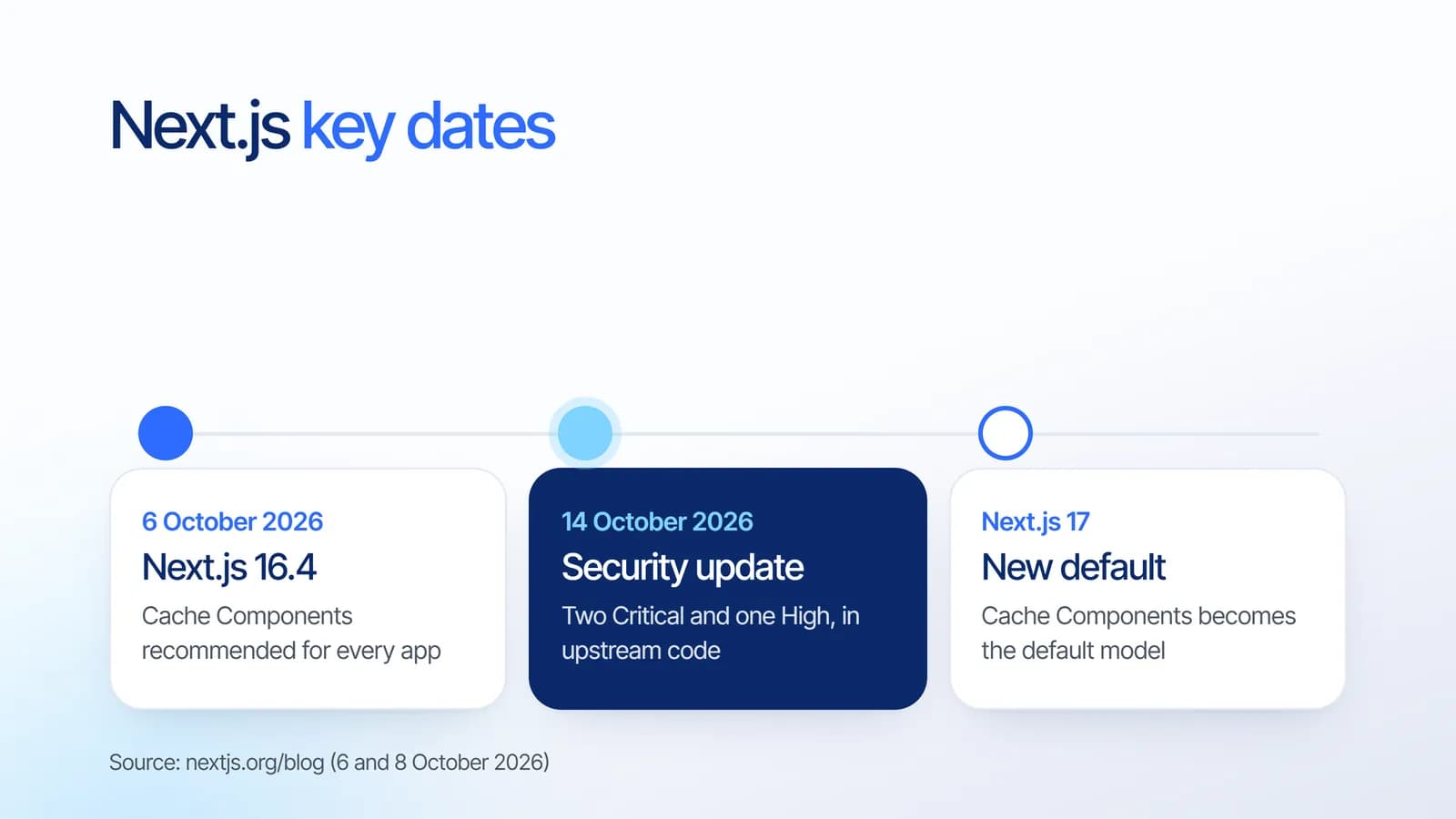
On 8 October 2026, the Next.js team announced an out-of-band security update for 14 October. It will address three vulnerabilities in upstream dependencies, two rated Critical and one High. Two of the fixes were postponed from the September security release because of upstream coordination.
Full advisories, affected versions and upgrade instructions will be published with the update, and the team asks everyone to upgrade as soon as it is available. Our article on the September Next.js security release explains why the days after a disclosure are the riskiest.
Should you adopt Cache Components now?
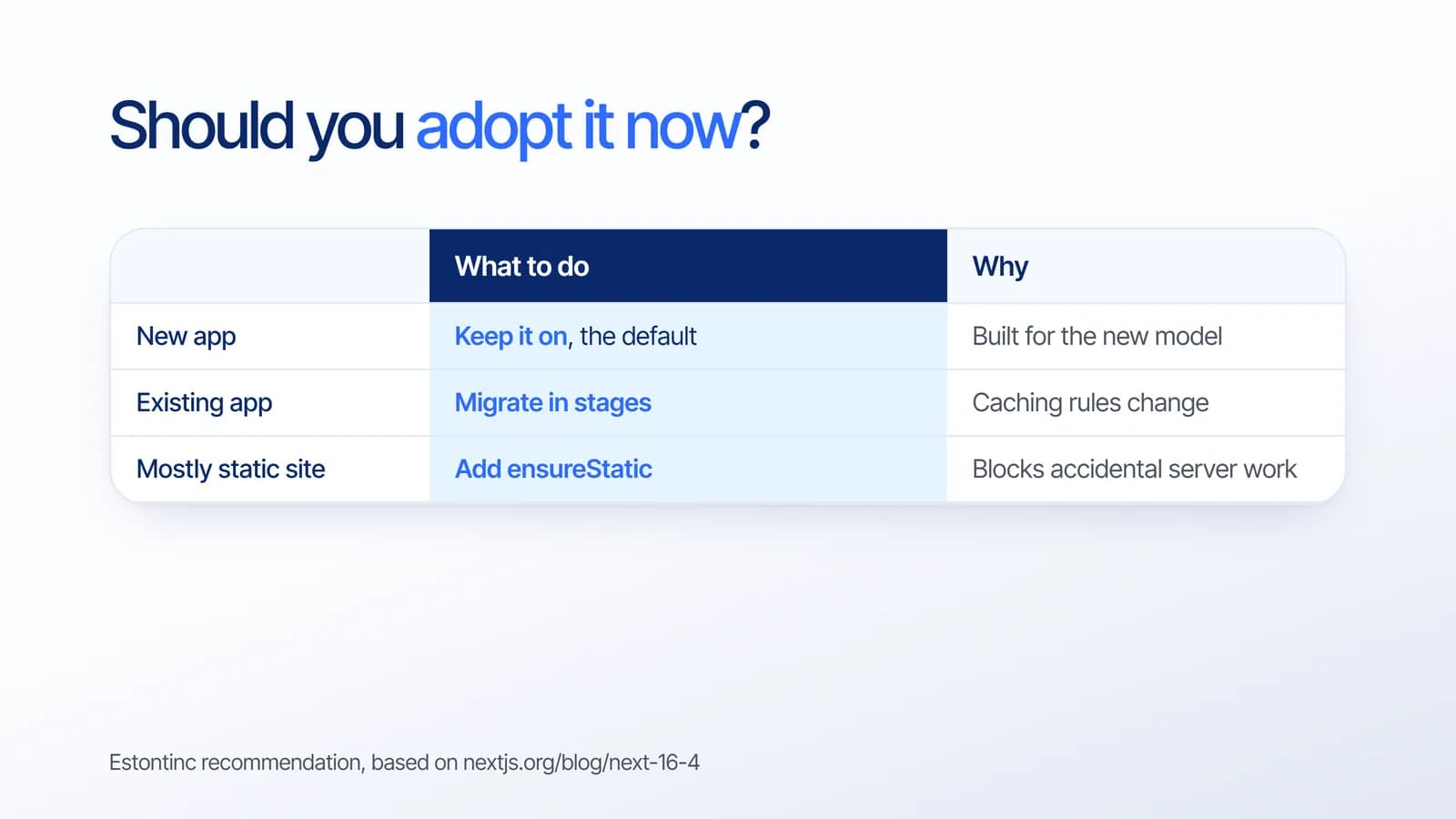
Based on our project experience, the answer depends on where your app is today:
- New app: keep the create-next-app default. You start on the model that Next.js 17 will use.
- Existing app: plan a staged migration. Cache Components replaces the implicit caching of earlier App Router versions, so caching behaviour should be tested page by page.
- Mostly static site: consider ensureStatic on layouts, so a single dynamic component cannot quietly raise your server bill.
Whatever you choose, apply the 14 October security update first. Feature work can wait a sprint, while a Critical fix should not. If performance is your main concern, our guide on finding why an app is slow shows how to measure before and after.
What it means for your business
Next.js is moving to a clearer caching model with lower running costs and faster pages, and the upgrade path is now partly automated. The real risk is falling behind: an app several versions old is harder to patch quickly when a Critical fix lands. Keeping your framework current is cheaper than an emergency upgrade.
How Estontinc helps
Estontinc is a software house in Malang with 100+ projects and 50+ clients over more than six years. Through our web development service we build and maintain Next.js sites, plan migrations such as the move to Cache Components, and test security patches before they reach production. Our cloud and DevOps team sets up CI/CD so a patch can ship within a day.
Tell us your Next.js version and hosting setup through the contact page, and we will reply within 24 hours with the steps you need.
Frequently asked questions
What is new in Next.js 16.4?
Next.js 16.4 recommends Cache Components for every app and enables it by default in new apps. It adds ensureStatic, the navigation() and prefetch() APIs, next upgrade --agent, lower memory use and compile times in development, smaller production bundles, and React 19.3 with stable View Transitions.
What are Cache Components in Next.js?
Cache Components is a programming model where developers mark specific components as cacheable with the 'use cache' directive. Cached parts can be served from the browser, a server cache or the build, while personalized parts render at request time. It replaces the implicit caching of earlier App Router versions.
When is the next Next.js security update?
The Next.js team plans an out-of-band security update on Wednesday, 14 October 2026. It addresses three vulnerabilities in upstream dependencies, two Critical and one High. Full advisories, affected versions and upgrade instructions will be published with the update, so plan time to upgrade that week.
Do I have to migrate my existing app to Cache Components?
Not immediately. Cache Components is recommended now and becomes the default in Next.js 17, so planning ahead makes sense. Because caching behaviour changes, migrate in stages and test each page. Security updates should always come first, before any migration work begins.
Sources
Facts and figures in this article come from these official sources.
- Web development
- Next.js
- Security
- Performance