EstontincPublished 3 min read
Deno Deploy is shutting down: what Deno users need to know and how to migrate
The Deno team is joining Cloudflare. Deno Deploy closes in six months and the runtime gets one more year of fixes. The timeline, what stays, and how to plan a migration without downtime.

Deno Deploy is shutting down. On 9 October 2026, Deno announced that its entire team is joining Cloudflare. Deno Deploy will keep operating for six months before it closes, and the Deno runtime will receive one more year of monthly bug fix and security releases before the team ends its development.
If your business runs anything on Deno, this is not a reason to panic, but it is a reason to plan now. This article explains what was announced, what happens to each Deno product, and the migration plan we recommend.
What Deno and Cloudflare announced
According to Deno, the team has decided to put its future work into a shared platform with Cloudflare, rather than continue developing a separate runtime and hosting service. Deno itself acknowledges that this is a consequential change for people who have built on it.
On the Cloudflare side, the Deno team will merge its project celld with workerd, the open-source runtime behind Cloudflare Workers. The goal, in Cloudflare’s words, is to radically simplify self-hosting Workers and Durable Objects, so developers can use the same building blocks on Cloudflare’s network or on their own infrastructure.
Deno Deploy shutdown timeline
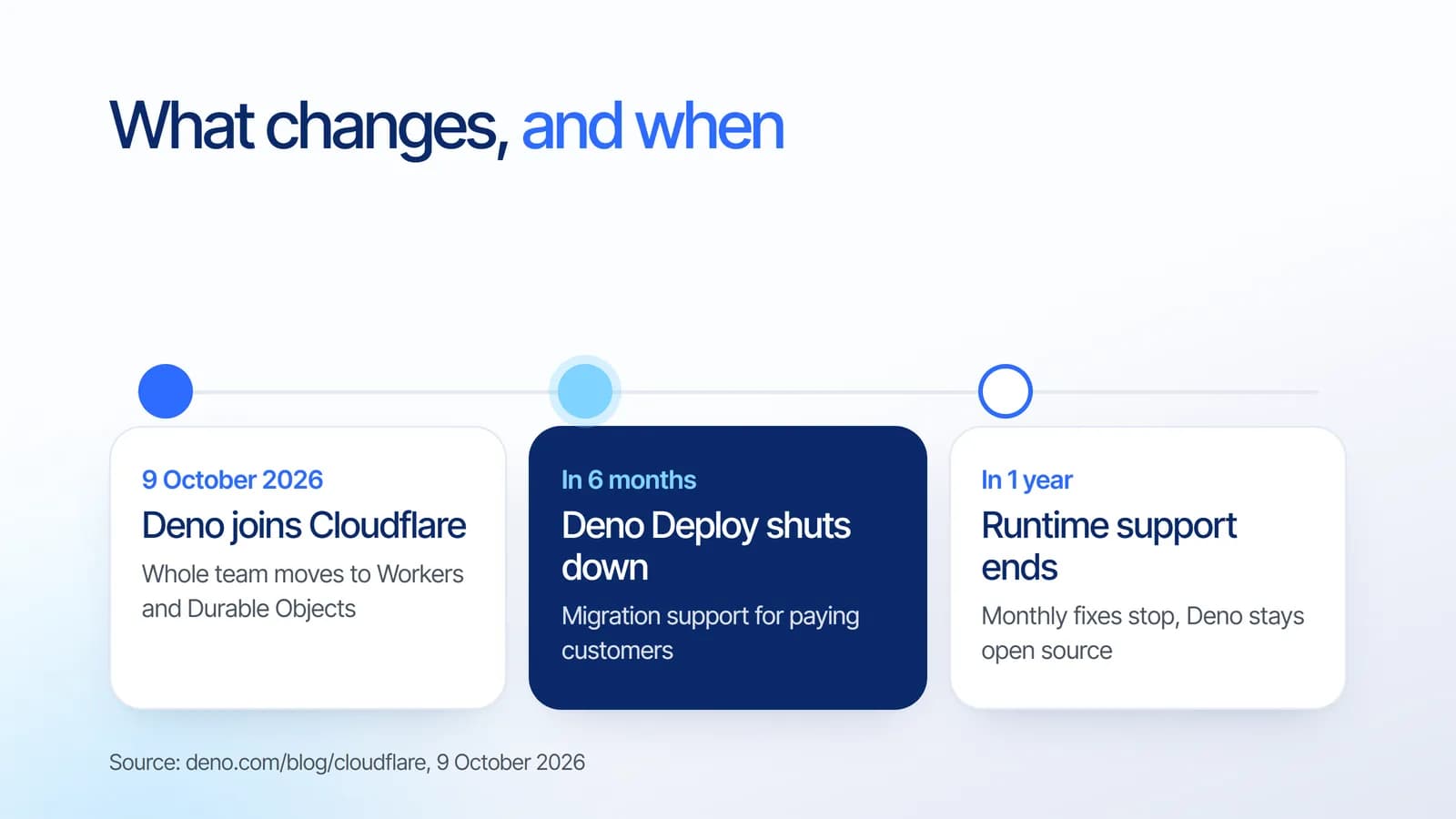
- Deno Deploy will continue operating for six months, then shut down. Deno will provide migration support for paying customers moving to Cloudflare.
- The Deno runtime will be supported for another year with monthly releases containing bug fixes and security updates. After that, the team will end its development. Deno will remain open source, and others are welcome to continue it.
- JSR, the JavaScript and TypeScript package registry, will continue operating.
- rusty_v8 will continue to be supported.
What this means for apps built on Deno
Apps hosted on Deno Deploy have the firmest deadline: they need a new home within six months. Apps that use the Deno runtime on your own servers keep working, and will still get security fixes for a year, but you should plan for a time when no new fixes arrive.
In our experience, platform changes like this are rarely an emergency on day one. They become one when the work starts in the final month. Six months is enough time to migrate calmly, test properly and switch over without downtime.
A calm migration plan
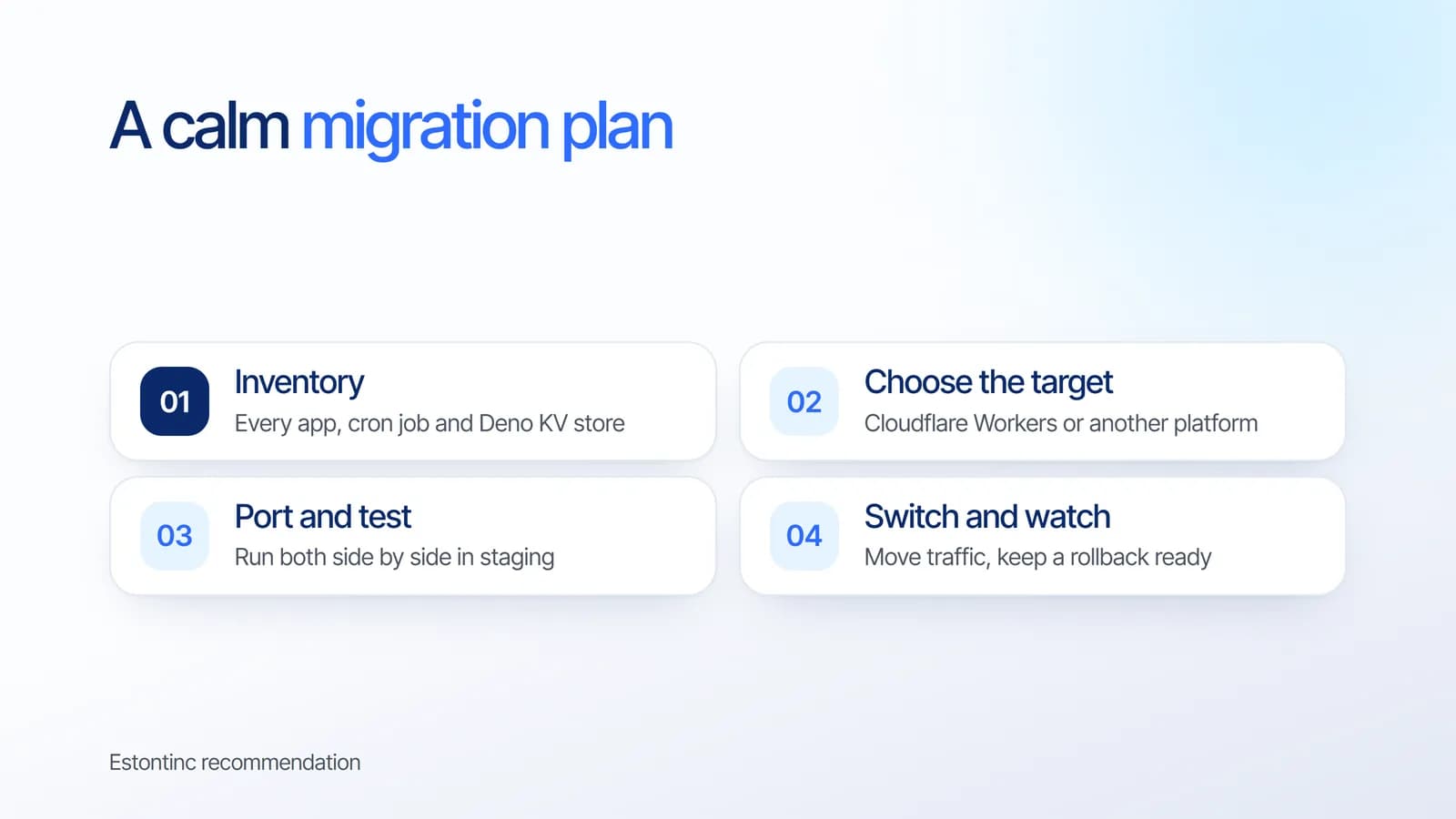
Based on our project experience, this is the plan we would follow:
- Take inventory. List every app, scheduled job, domain and data store that runs on Deno Deploy, including any data you keep in Deno-specific storage.
- Choose the target. Cloudflare Workers is the natural path, given the migration support Deno is offering to paying customers, but other hosting platforms are also an option depending on your stack and budget.
- Port and test side by side. Run the new version in a staging environment next to the current one, and compare behaviour with real requests.
- Switch and watch. Move traffic gradually, monitor errors and performance, and keep the old deployment ready as a rollback until you are confident.
Our guide to shipping in small, reviewed steps explains how to keep a migration like this safe.
Checklist before you switch traffic
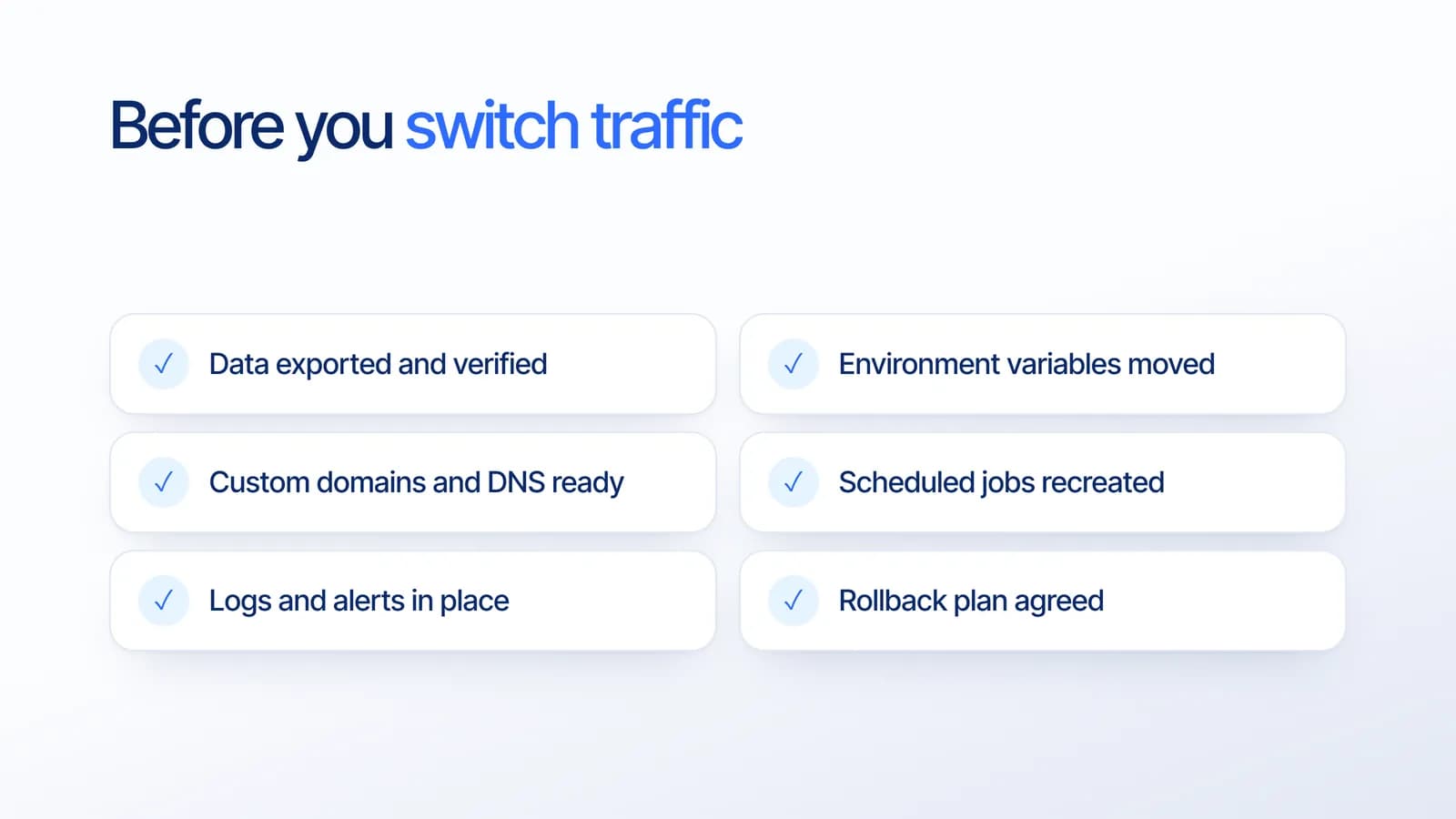
- Data exported and verified, with a test restore on the new platform.
- Environment variables and secrets moved, never pasted into code. See how to protect API keys in your app.
- Custom domains and DNS ready, with short TTLs before the switch.
- Scheduled jobs recreated on the new platform.
- Logs and alerts in place before the first real user arrives.
- A rollback plan agreed by everyone involved.
What it means for your business
The broader lesson applies to any technology choice: know which parts of your product depend on a single vendor, and keep a migration path in mind. We suggest reviewing your hosting and key dependencies once a year, so a change like this becomes a planned project rather than a scramble.
How Estontinc helps
Estontinc is a software house in Malang with 100+ projects and 50+ clients over more than six years. Our cloud and DevOps team audits applications and plans migrations between hosting platforms, including Cloudflare Workers. Through our web development service we port and test the application itself, so the switch happens without downtime.
We work under NDA, run weekly demos, and offer maintenance with monitoring and backups after the move. Tell us what runs on Deno through the contact page, and we will reply within 24 hours.
Frequently asked questions
Is Deno Deploy shutting down?
Yes. On 9 October 2026, Deno announced that its team is joining Cloudflare. Deno Deploy will continue operating for six months and then shut down. Deno will provide migration support for paying customers moving to Cloudflare, so it is worth starting a migration plan now.
What happens to the Deno runtime?
The Deno runtime will be supported for another year with monthly releases containing bug fixes and security updates. After that, the Deno team will end its development. Deno will remain open source, and others are welcome to continue the project.
Will JSR keep working after Deno joins Cloudflare?
Yes. According to Deno’s announcement, JSR, the JavaScript and TypeScript package registry, will continue operating. Deno also said it will continue supporting rusty_v8. The products that change are Deno Deploy, which shuts down in six months, and the runtime, whose development ends after a year.
How should I migrate away from Deno Deploy?
Start with an inventory of every app, scheduled job, domain and data store. Choose a target such as Cloudflare Workers, port and test the app side by side in staging, then switch traffic gradually with a rollback ready. Start early so the migration is calm rather than rushed.
Sources
Facts and figures in this article come from these official sources.
- Cloud & DevOps
- Web development
- Cloudflare
- Migration