EstontincPublished 3 min read
How to estimate AI API costs before you build, with Gemini 4 Argon as an example
AI models are priced per token, which makes costs easy to underestimate. A simple way to estimate them, a worked example with Gemini 4 Argon, and the levers that keep the bill predictable.
How much does an AI API cost? Most AI models are priced per token, so the answer depends on how much text goes in, how much comes out, and how often. On 13 October 2026, Google released Gemini 4 Argon, its newest frontier model, with an introductory price that changes on 30 November 2026. That makes it a good example for learning to estimate costs before you build.
This article explains how token pricing works, walks through a worked example, and lists the levers that keep an AI bill predictable.
How AI API pricing works
Models read and write text in small units called tokens. Providers usually charge separately for input tokens, the prompt and any documents you send, and output tokens, the answer the model writes. Output tokens usually cost more. Many providers also discount cached input, repeated content such as long instructions that are sent again with every request.
Gemini 4 Argon at a glance
- What it is for: Google describes Argon as built for deep work in coding, finance, legal, cybersecurity and science, ranking #1 on the Vals Index.
- Introductory price: $2 per million input tokens and $10 per million output tokens, with cached input tokens 95% off.
- After 30 November 2026: $4 per million input tokens and $20 per million output tokens.
- Context: a 1M unified input-output token limit through the Gemini API.
- Where: the Gemini API in Google AI Studio and the Gemini platform, and, according to GitHub, GitHub Copilot for Pro+, Max, Business and Enterprise users.
Google also shared results from its own teams: Argon in Antigravity increased agentic code submissions by more than 35% while reducing code rollbacks by nearly a third.
A worked example
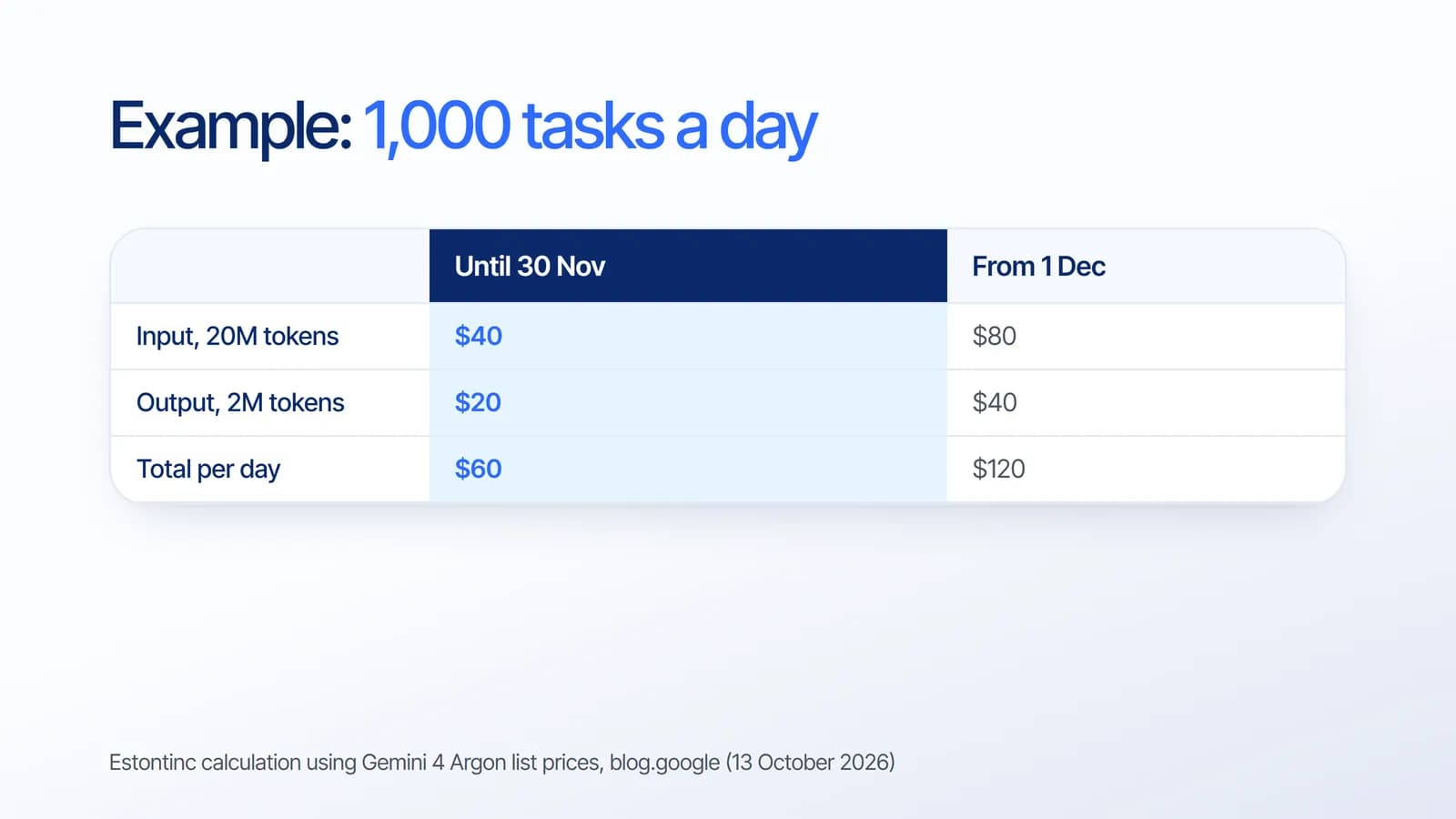
Imagine a feature that reviews documents. Each task sends about 20,000 input tokens and receives about 2,000 output tokens, and it runs 1,000 times a day. Using Argon's published prices, our calculation is:
- Input: 1,000 × 20,000 = 20 million tokens, so $40 a day at $2, or $80 at $4.
- Output: 1,000 × 2,000 = 2 million tokens, so $20 a day at $10, or $40 at $20.
- Total: $60 a day during the introductory period, and $120 a day after 30 November.
Caching changes the picture. If 16 million of those input tokens are a repeated instruction set that can be cached at 95% off, that part costs about $1.60 instead of $32 at the introductory price. Small design choices like this often matter more than the headline price.
How to estimate your own cost
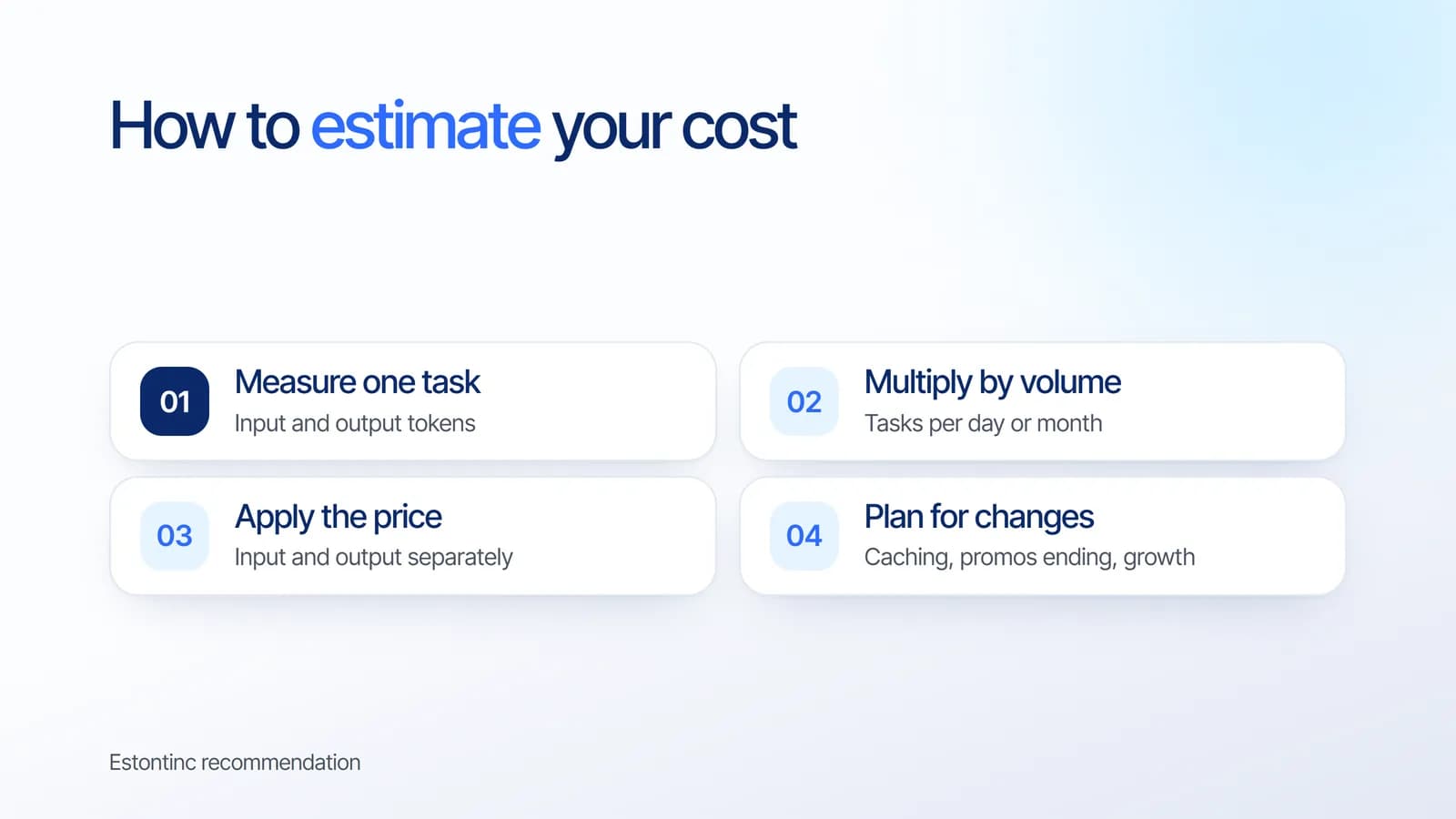
- Measure one real task. Count input and output tokens with real data, not a short test prompt.
- Multiply by volume. Use realistic tasks per day or month, including peaks.
- Apply the price to input and output separately, using the provider's current price list.
- Plan for changes: caching, introductory prices ending, and usage growing as more people adopt the feature.
Not every task needs a frontier model. A smaller, cheaper model can handle simple, high-volume work, while a model like Argon is saved for complex tasks. Our guide on choosing the right AI model for your business compares these trade-offs.
What it means for your business
Capable AI models are becoming more accessible, which makes features like document review, code migration and workflow automation realistic for more companies. The risk is a surprise bill. Estimating cost per task before you build, and monitoring usage after launch, keeps AI projects on budget.
How Estontinc helps
Estontinc is a software house in Malang with 100+ projects and 50+ clients over more than six years. Through our AI development service we help choose models, design prompts and caching, and build AI features into your existing systems. Our cloud and DevOps team sets up monitoring so token spend stays visible.
Tell us which process you want AI to help with through the contact page, and we will reply within 24 hours with a cost estimate approach.
Frequently asked questions
How are AI APIs priced?
Most AI APIs charge per token, usually per million tokens. Input tokens, the prompt and documents you send, are priced separately from output tokens, the answer the model writes, and output usually costs more. Many providers discount cached input that is sent repeatedly.
How much does Gemini 4 Argon cost?
Google launched Gemini 4 Argon on 13 October 2026 at an introductory price of $2 per million input tokens and $10 per million output tokens, with cached input 95% off. After 30 November 2026, the price becomes $4 per million input tokens and $20 per million output tokens.
How do I estimate the cost of an AI feature?
Measure the input and output tokens of one realistic task, multiply by the number of tasks per day or month, and apply the input and output prices separately. Then plan for caching, introductory prices ending, and growth in usage as more people adopt the feature.
How can I reduce AI API costs?
Cache repeated instructions where the provider offers discounts, keep prompts and documents focused, use smaller models for simple high-volume tasks, and reserve frontier models for complex work. Monitor token usage after launch so unexpected growth is caught early and fixed quickly.
Sources
Facts and figures in this article come from these official sources.
- AI
- AI development
- Gemini
- Cost