EstontincPublished 4 min read
GPT-6.1 Terra: price, speed and when to use it instead of GPT-6.1 Sol
GPT-6.1 Terra costs half as much as GPT-6.1 Sol and finished tasks more than three times faster in AWS's reported evaluation. The prices, specs, use cases and a safe way to test it on your own data.
GPT-6.1 Terra is OpenAI's newest model, released on 26 October 2026. On OpenAI's model page it costs $1 per million input tokens and $5 per million output tokens, half the price of GPT-6.1 Sol, with the same 1.05 million token context window. If your chatbot, document assistant or AI automation runs on Sol today, Terra is worth a side-by-side test this week.
This article sums up what OpenAI, AWS and GitHub published on launch day, how Terra compares with the rest of the GPT-6 family, what it is good for, and the steps we use to test a model switch without surprises.
What OpenAI released on 26 October 2026
According to the OpenAI API changelog, GPT-6.1 Terra is "a fast, efficient model for visual reasoning, precise computer use, and clear, natural writing". It is available in the Responses API and the Chat Completions API from day one.
- Amazon Bedrock: AWS announced general availability on the same day. AWS says Terra improves visual reasoning, computer use, factuality and natural writing over GPT-5.6 Terra, accepts text and image inputs, and supports up to 1 million input tokens.
- GitHub Copilot: GitHub made Terra generally available in Copilot, designed for everyday agentic coding and terminal work at a lower cost than GPT-6.1 Sol. In GitHub's early testing it solved noticeably more terminal and C# coding tasks than GPT-5.6 Terra.
GPT-6.1 Terra price compared with GPT-6.1 Sol
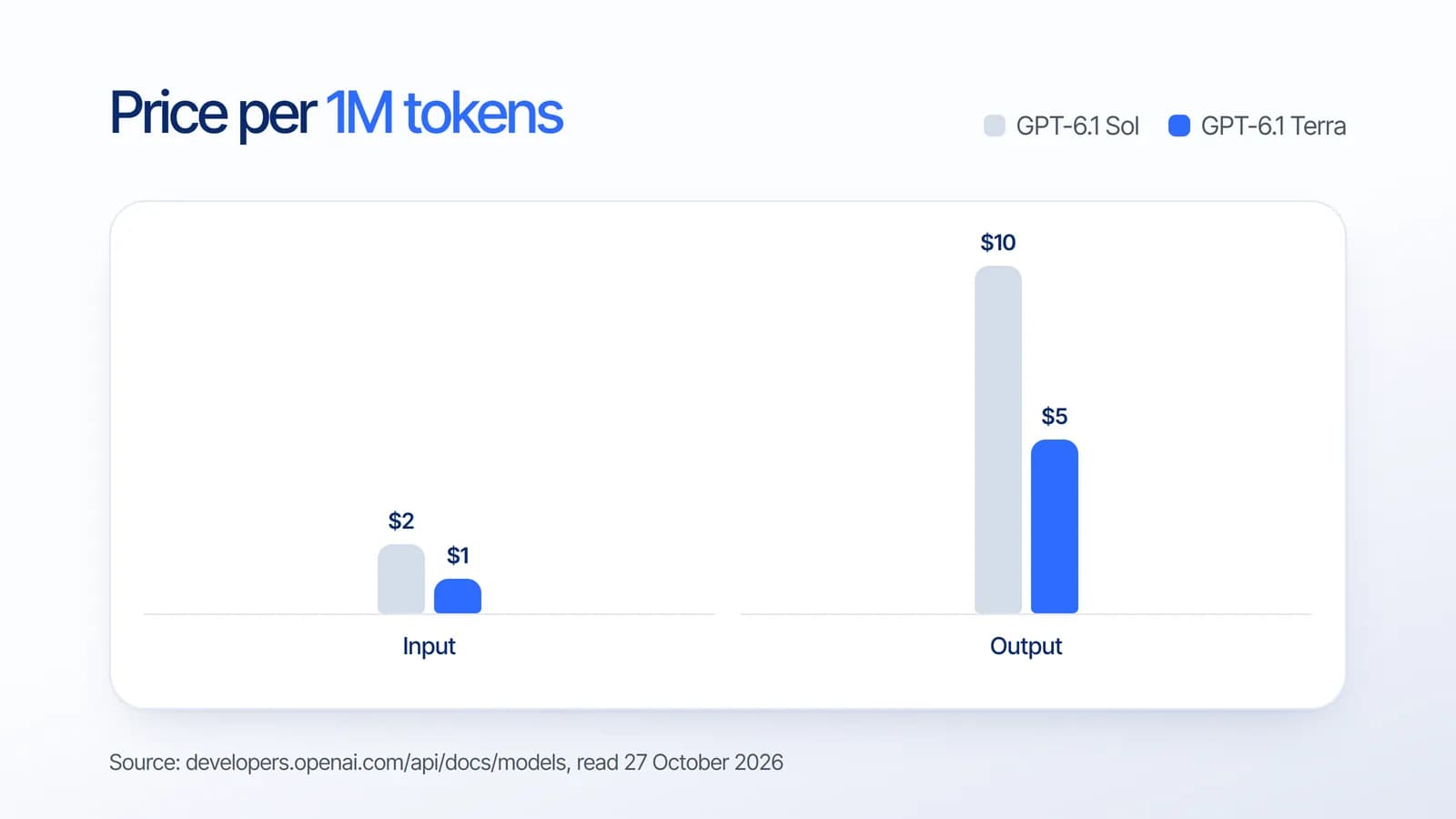
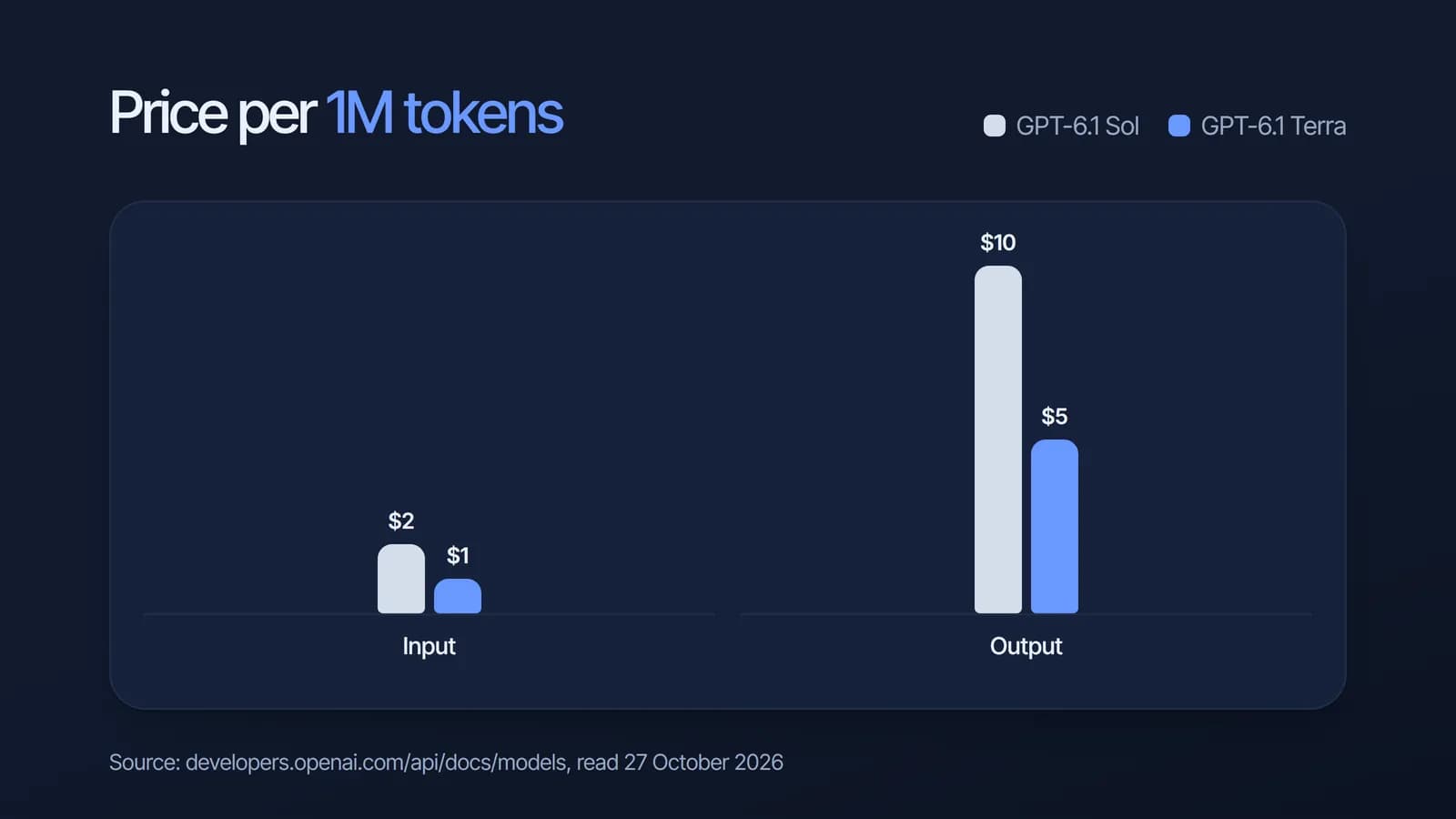
The OpenAI models page, read on 27 October 2026, lists these prices per million tokens:
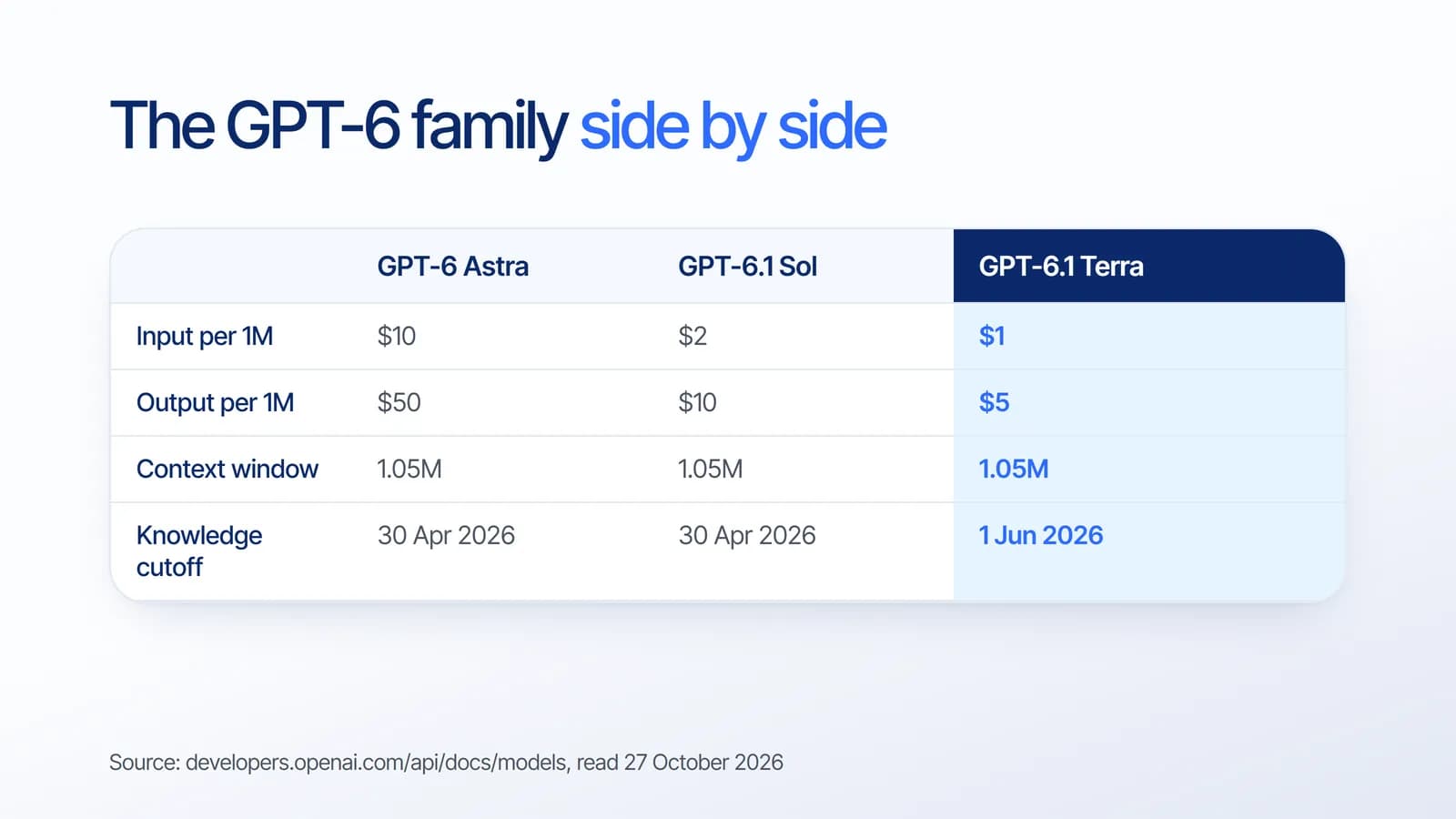
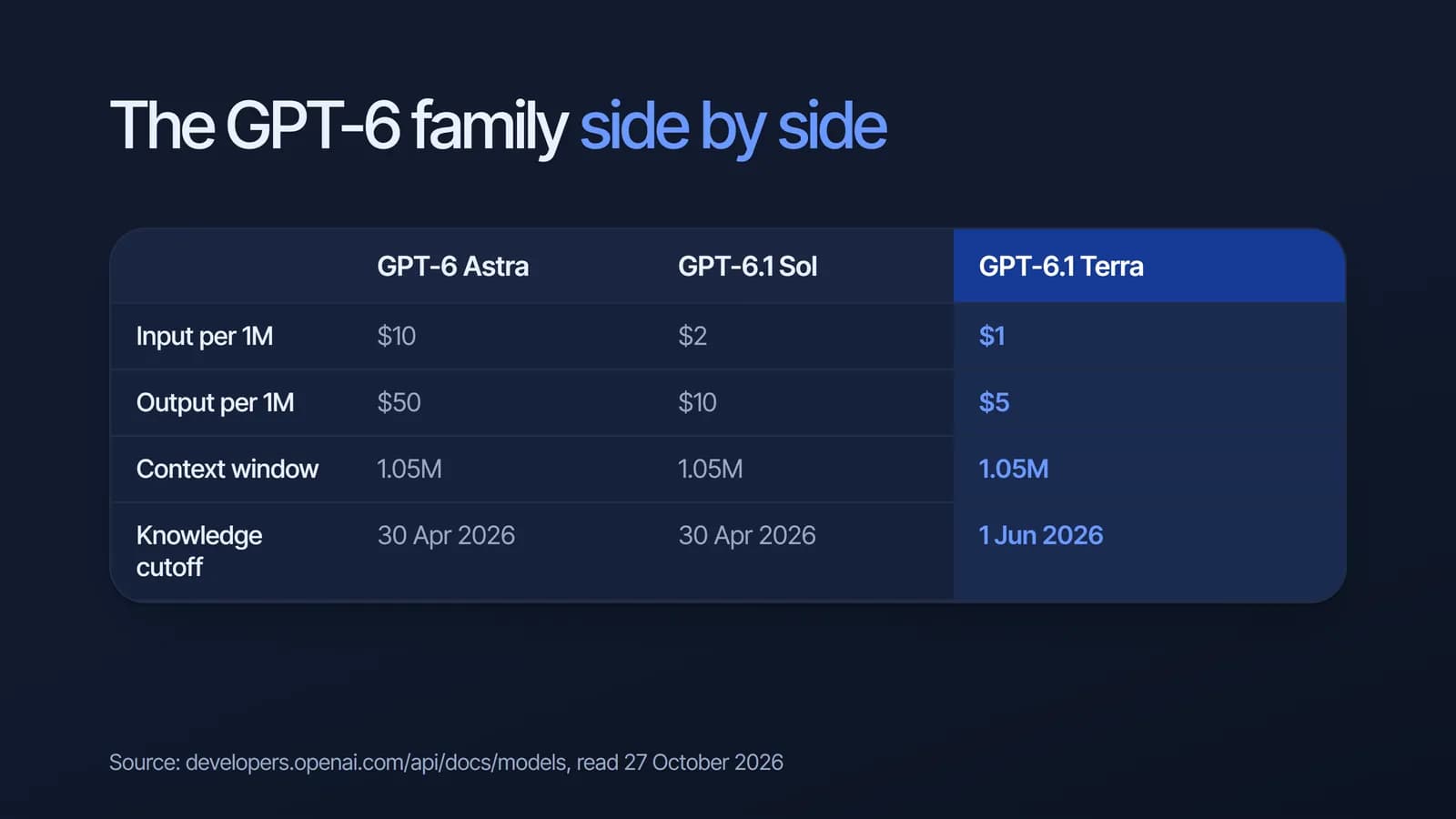
- GPT-6 Astra: $10 input and $50 output, OpenAI's most capable model.
- GPT-6.1 Sol: $2 input and $10 output.
- GPT-6.1 Terra: $1 input and $5 output, with a knowledge cutoff of 1 June 2026, the most recent of the three.
All three have a 1.05 million token context window and up to 128,000 output tokens. Terra also supports a reasoning effort of none, which is useful for simple tasks where you want the fastest possible reply.
How fast is GPT-6.1 Terra?
AWS reports that in OpenAI's Agents' Last Exam evaluation, Terra scored 15 percentage points higher than GPT-5.6 Terra, performed on par with GPT-6 Astra, and completed tasks more than three times faster than GPT-6 Astra and GPT-6.1 Sol. Treat this as a vendor benchmark: it is a strong signal, but the only result that matters for your business is how Terra performs on your own cases.
What GPT-6.1 Terra is good for
- Reading documents and images: invoices, forms, photos and technical drawings, thanks to stronger visual reasoning.
- Computer use: agents that click through software and complete steps in business systems.
- Everyday coding: GitHub positions it for agentic coding and terminal work on well-scoped tasks.
- Natural writing: drafting replies, proposals and summaries where tone matters.
For the hardest reasoning tasks, OpenAI still positions GPT-6 Astra as its most capable model. A common pattern is to route most requests to a cheaper model and send only the difficult ones to a stronger one. Our guide on how to choose an AI model for your business explains how to decide.
How to test a switch from Sol to Terra
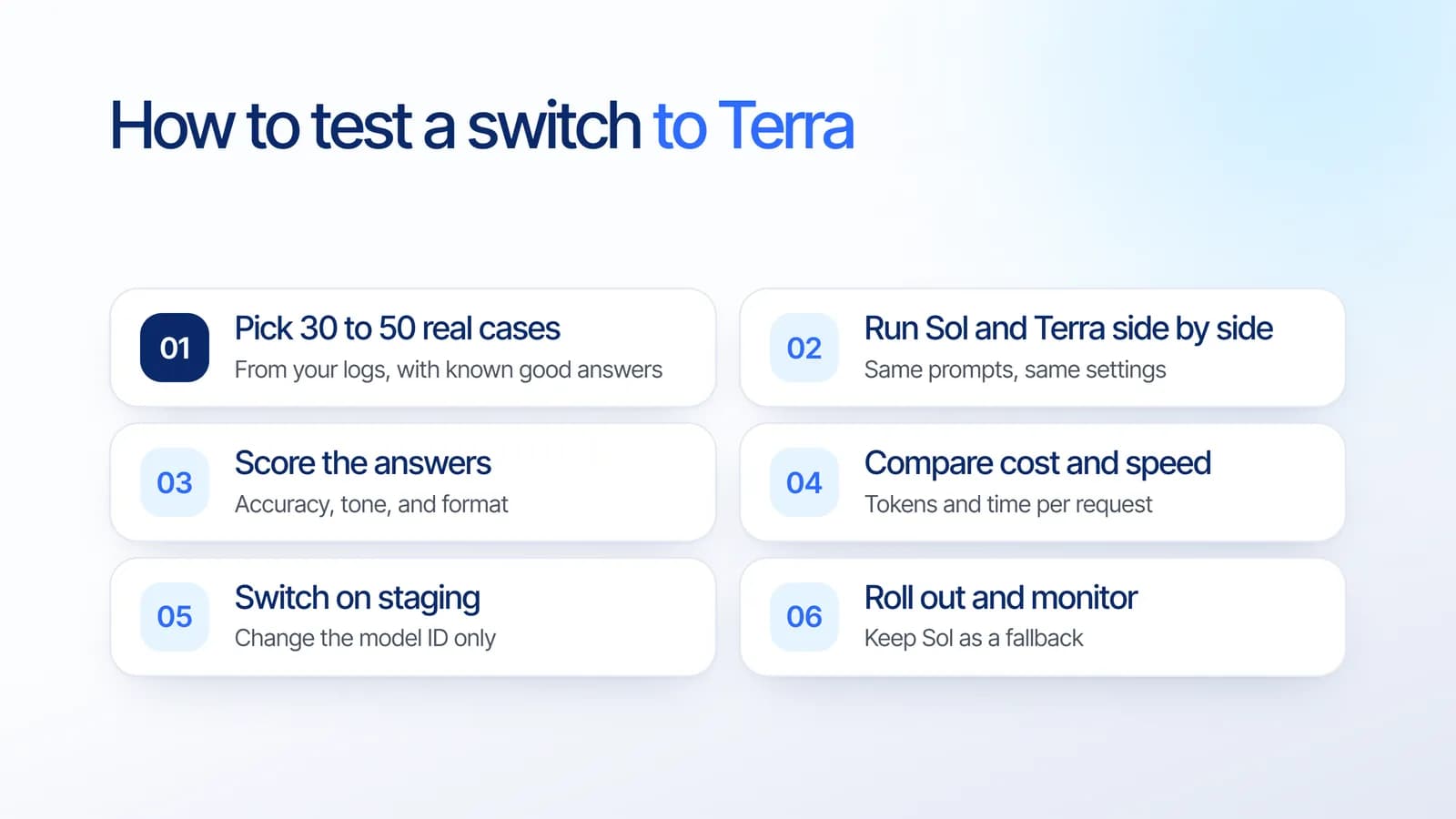
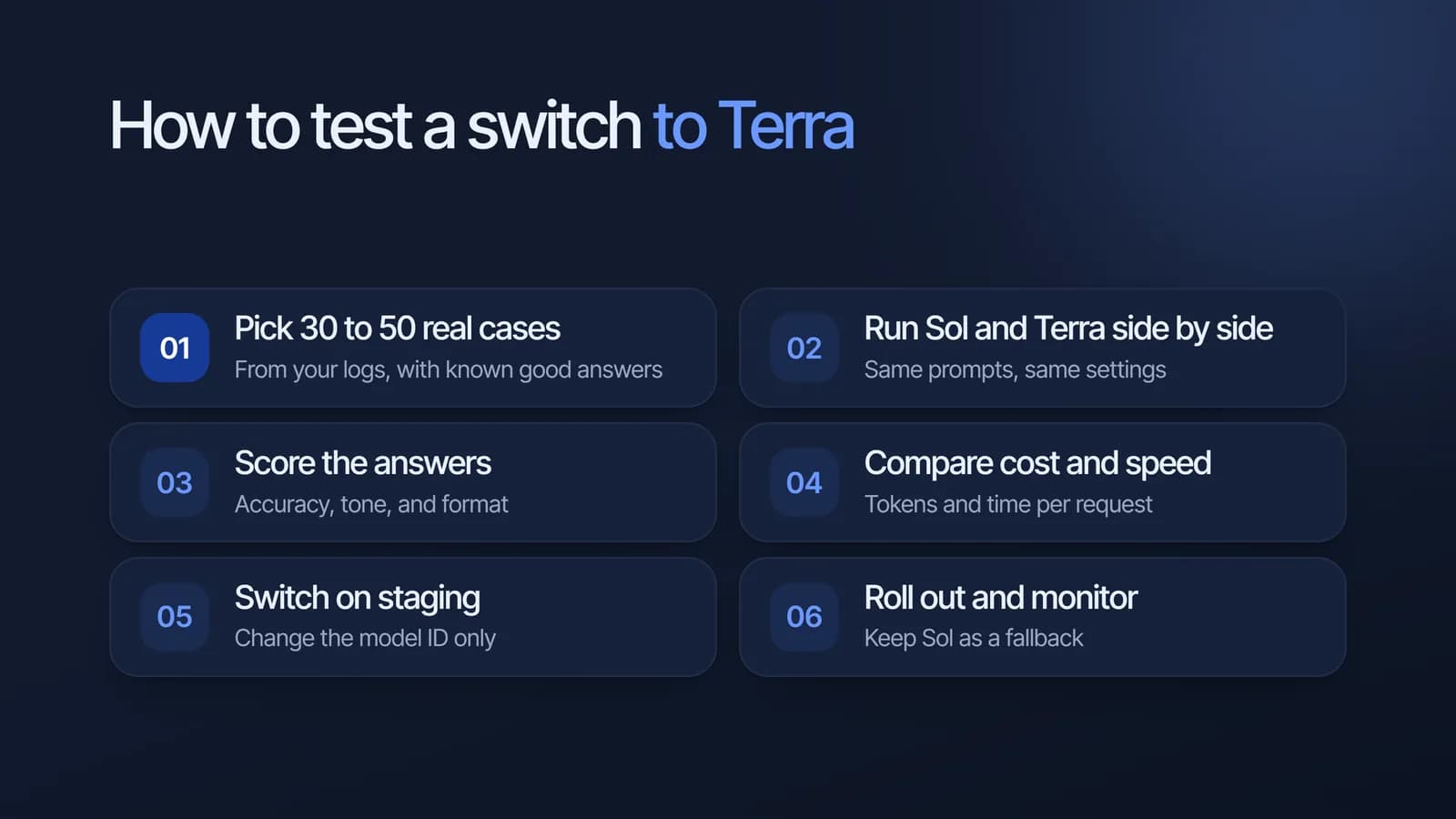
- Pick 30 to 50 real cases from your logs, with answers you know are good.
- Run Sol and Terra side by side with the same prompts and settings.
- Score the answers for accuracy, tone and format, ideally with the people who own the process.
- Compare cost and speed per request, using the token counts from the API.
- Switch on staging by changing only the model ID, so any difference comes from the model.
- Roll out and monitor, keeping Sol as a fallback for the first weeks.
If you still keep prompts in saved prompt objects, note that OpenAI shuts down the v1/prompts API on 30 November 2026. Our article on the OpenAI Agent Builder, Evals and Prompts API shutdown explains how to move them into code first.
What it means for your business
Halving the token price does not halve your AI bill automatically, but for workloads where Terra's answers hold up, it comes close. Customer service bots, document extraction and internal assistants are usually the first candidates, because they run many similar requests every day. More ways to cut costs are in our guide on how to reduce AI costs.
How Estontinc helps
Estontinc is a software house in Malang, Indonesia, with 100+ projects and 50+ clients over more than six years. For teams using OpenAI models we can:
- Run a side-by-side test of Sol and Terra on your real cases and report quality, cost and speed.
- Switch models safely on staging and production, as part of our AI development service.
- Build the surrounding system with our custom software team: routing, monitoring and cost dashboards.
- Keep it maintained after release as OpenAI and other providers release new models.
We work under NDA, you own the source code, and we communicate in English, Indonesian or Japanese. Want to know what Terra would cost for your workload? Send the details through the contact page and we will reply within 24 hours.
Frequently asked questions
How much does GPT-6.1 Terra cost?
OpenAI's models page lists GPT-6.1 Terra at $1 per million input tokens and $5 per million output tokens. That is half the price of GPT-6.1 Sol, which costs $2 and $10, and a tenth of GPT-6 Astra at $10 and $50. All three have a 1.05 million token context window.
When was GPT-6.1 Terra released?
OpenAI released GPT-6.1 Terra on 26 October 2026, according to its API changelog. On the same day AWS made it generally available on Amazon Bedrock and GitHub made it generally available in GitHub Copilot. It is available in both the Responses API and the Chat Completions API.
Is GPT-6.1 Terra better than GPT-6.1 Sol?
It is cheaper and, according to AWS, completed tasks more than three times faster than Sol and Astra in the Agents' Last Exam evaluation while scoring on par with Astra. Whether it is better for you depends on your tasks, so test both on 30 to 50 real cases before switching.
What is GPT-6.1 Terra best used for?
OpenAI describes it as a fast, efficient model for visual reasoning, precise computer use, and clear, natural writing. Good candidates include document and image reading, agents that operate business software, everyday coding tasks, and drafting replies or proposals. For the hardest reasoning, OpenAI positions GPT-6 Astra as its most capable model.
Sources
Facts and figures in this article come from these official sources.
- AI
- OpenAI
- AI costs
- Custom software