EstontincPublished 3 min read
Internet outages in Q3 2026: how to keep your business app running when the network fails
Cloudflare's Q3 2026 report counts 49 internet disruptions, from power failures to natural disasters. What happened, why one facility took down a country's traffic, and six ways to keep your app running.

Internet outages happen more often than most businesses plan for. Cloudflare Radar recorded 49 internet disruptions worldwide between July and September 2026, according to a report published on 27 October. Power outages caused 14 of them and natural disasters caused 5. If your point-of-sale, ordering or internal system stops completely when the connection drops, this report is a good reason to review how it handles failure.
This article sums up what Cloudflare observed, why a single facility can take down a whole country's traffic, and six practical steps we use to keep client applications running during an outage.
What Cloudflare saw in Q3 2026
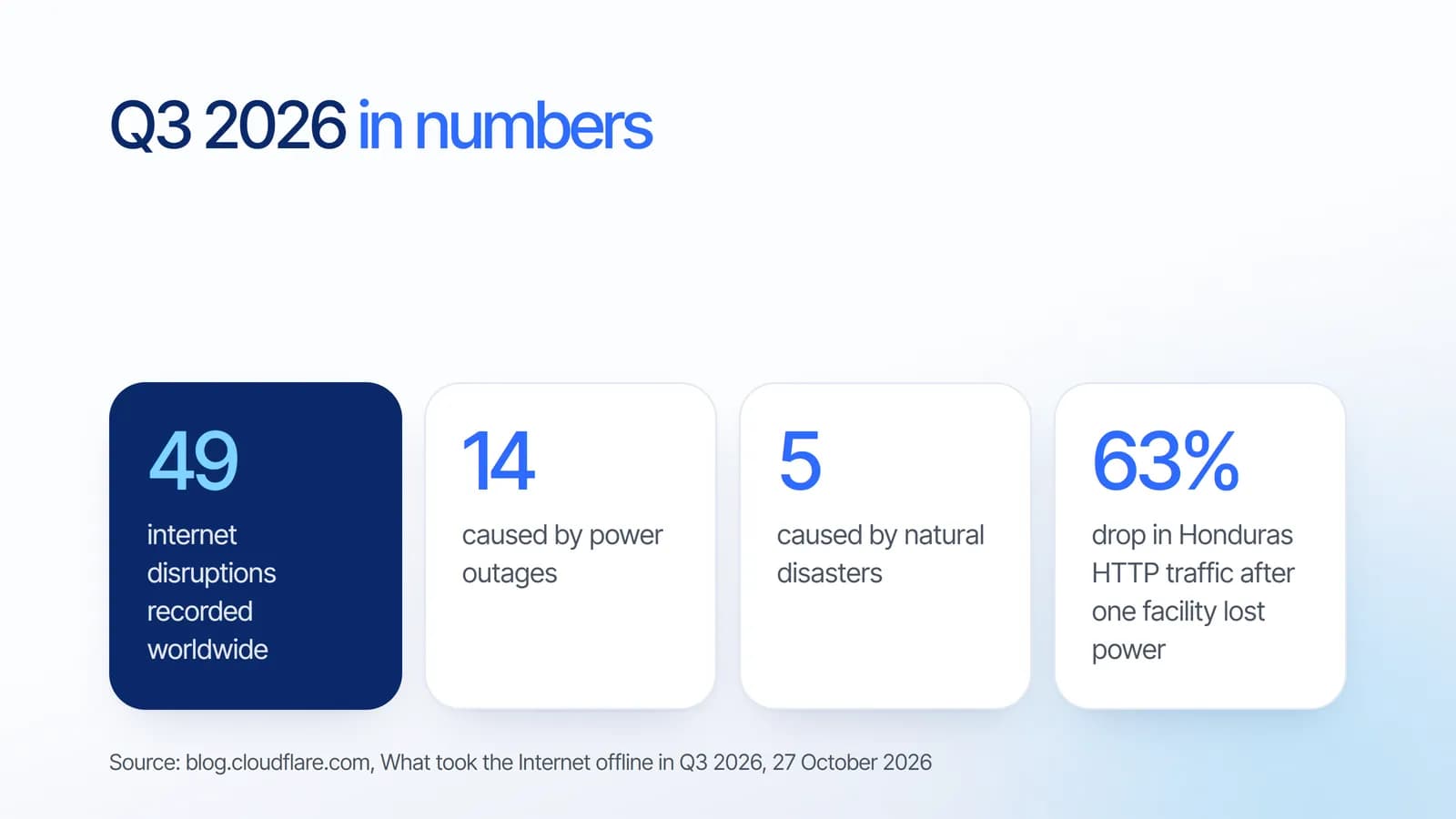
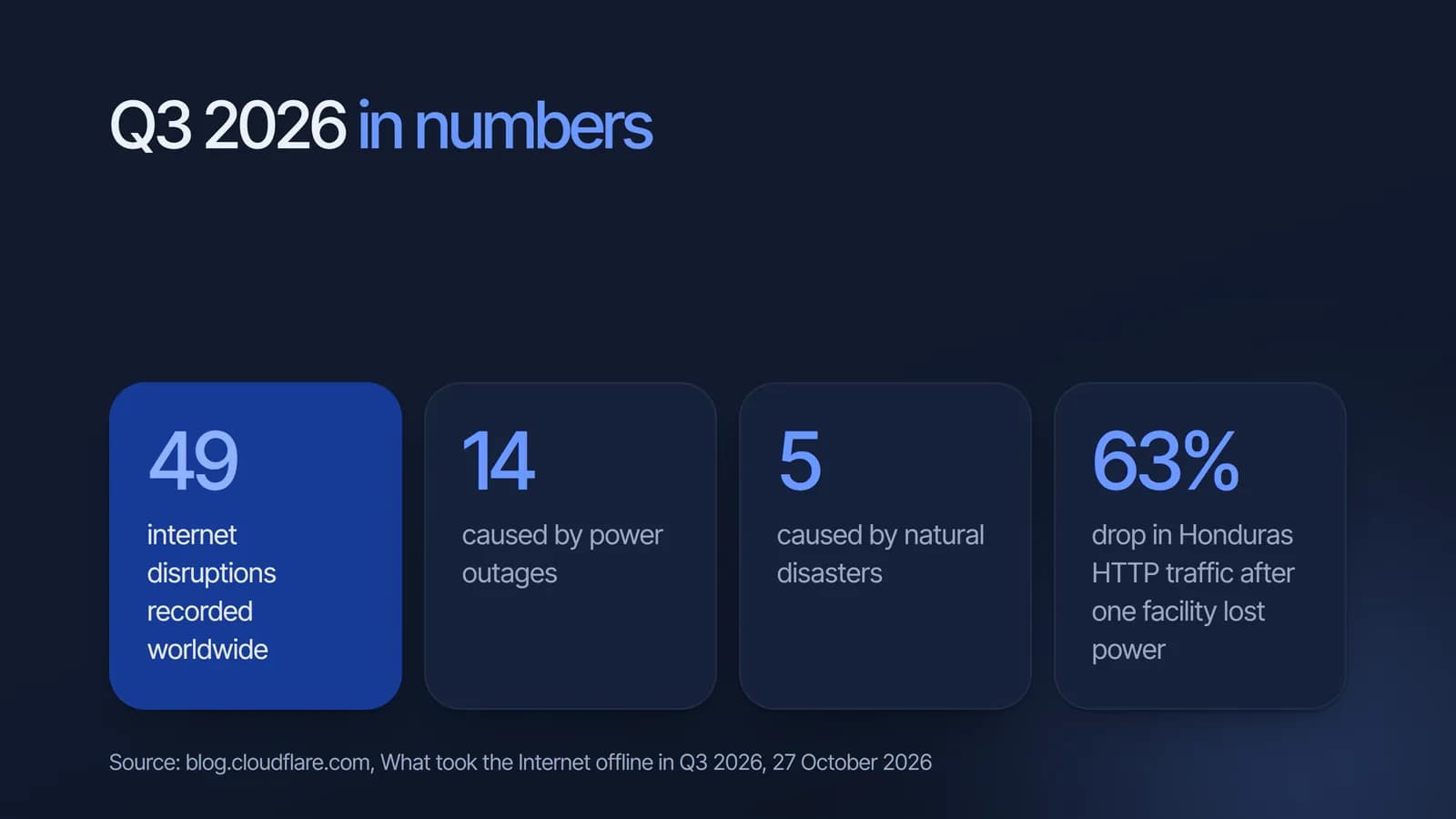
Cloudflare handles more than 20% of the web's traffic, which gives it a wide view of how the internet behaves. Its Q3 2026 disruption summary lists these findings:
- 49 disruptions in total across July, August and September 2026.
- Power outages were the second most common cause, with 14 incidents. When power fails, routers, mobile base stations, data centers and interconnection facilities can fail with it.
- Natural disasters caused 5 disruptions, damaging electricity and telecom infrastructure.
- Many disruptions were short: 14 saw traffic return to typical levels in under an hour, and 16 recovered in less than three hours.
- No country is immune. Cloudflare points to outages in the United States, Japan and Portugal, countries with a strong history of internet resilience.
How one facility can take a country offline
The clearest example is Honduras. On 10 September 2026, a power failure at an interconnection facility affected at least 11 major providers. For about three hours, HTTP traffic across the country fell by 63%. Cloudflare notes that concentrated traffic exchange points can become single points of failure. Two providers whose connectivity appears to rely on infrastructure outside the country were unaffected.
Your own systems have the same pattern on a smaller scale: one server, one database, one internet link or one cloud region that everything depends on. When that one thing fails, the whole service stops.
Six ways to keep your app running during an outage
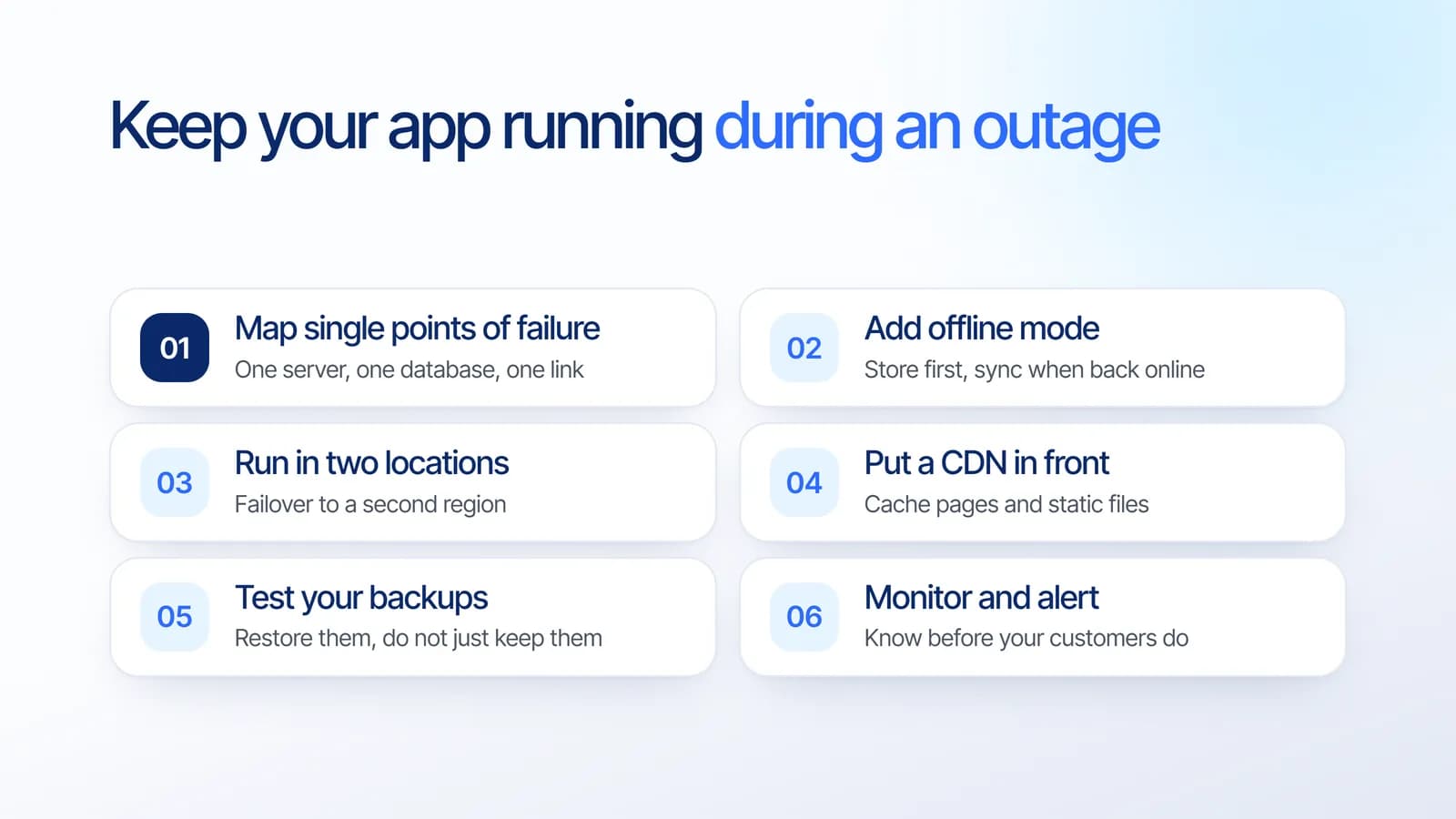
- Map your single points of failure. List every server, database, third-party API and internet link the system needs, and mark the ones with no backup.
- Add offline mode to mobile and point-of-sale apps. Store transactions on the device first, then sync them when the connection returns, and show users a clear status.
- Run in more than one location. Keep a second region or provider ready to take over, with data replicated, so one data center going dark does not stop the service.
- Put a CDN in front of your website. Cached pages and files can still load while the origin server is slow or briefly unreachable.
- Test your backups by restoring them. A backup that has never been restored is a guess, not a plan.
- Monitor and alert. Know about an outage before customers tell you, and keep a simple status page or message ready.
These are our recommendations from client projects, not part of Cloudflare's report. Not every system needs all six; start with the ones that protect revenue first. If your app feels unreliable even without an outage, our guide on why your app is slow covers the most common causes.
What it means for your business
A short outage is still costly when it hits the checkout, the cashier or the system your staff use to take orders. Most of the disruptions in Cloudflare's report were outside any single company's control: power grids, storms, earthquakes and cable cuts. What a business can control is how its own software behaves when the network disappears for an hour.
Resilience is also cheaper to design in than to bolt on later. Offline mode, failover and tested backups are easiest to add while an app is being built or during a planned update, just like security patches, as we wrote about the PHP security update.
How Estontinc helps
Estontinc is a software house in Malang, Indonesia, with 100+ projects and 50+ clients over more than six years. To make your systems more resilient we can:
- Audit single points of failure in your servers, databases, integrations and network links.
- Add offline mode and sync to mobile and point-of-sale apps, through our mobile app development service.
- Set up failover, CDN, backups and monitoring with our cloud and DevOps team.
- Keep it maintained after release with bug fixes, updates, monitoring and backups.
We work under NDA, you own the source code, and we communicate in English, Indonesian or Japanese. Want to know how your critical system would handle an outage? Send the details through the contact page and we will reply within 24 hours.
Frequently asked questions
How many internet outages happened in Q3 2026?
Cloudflare Radar recorded 49 internet disruptions worldwide between July and September 2026, according to its report published on 27 October 2026. Power outages caused 14 of them and natural disasters caused 5. Many were short: 14 saw traffic return to typical levels in under an hour.
What causes internet outages?
In Cloudflare's Q3 2026 report, causes included power outages, natural disasters such as earthquakes and storms, cable cuts and attacks on individual networks. Power failures were the second most common cause, because routers, base stations, data centers and interconnection facilities stop working when electricity fails.
How can a business app keep working without internet?
Add offline mode so the app stores transactions on the device and syncs them when the connection returns. For servers, run in more than one location with replicated data, put a CDN in front of the website, test backups by restoring them, and monitor so you hear about outages first.
What is a single point of failure?
It is one component that the whole system depends on, such as a single server, database, internet link or interconnection facility. Cloudflare's report shows how a power failure at one facility in Honduras cut national HTTP traffic by 63% for about three hours. Removing these points is the core of resilience.
Sources
Facts and figures in this article come from these official sources.
- Cloud
- DevOps
- Mobile app
- Maintenance