EstontincPublished 5 min read
.NET 8 end of support on 10 November 2026: what to upgrade and how
On 10 November 2026 Microsoft stops patching .NET 8 and .NET 9. Which versions are affected, what the support policy says, and how to move to .NET 10 LTS before the date.
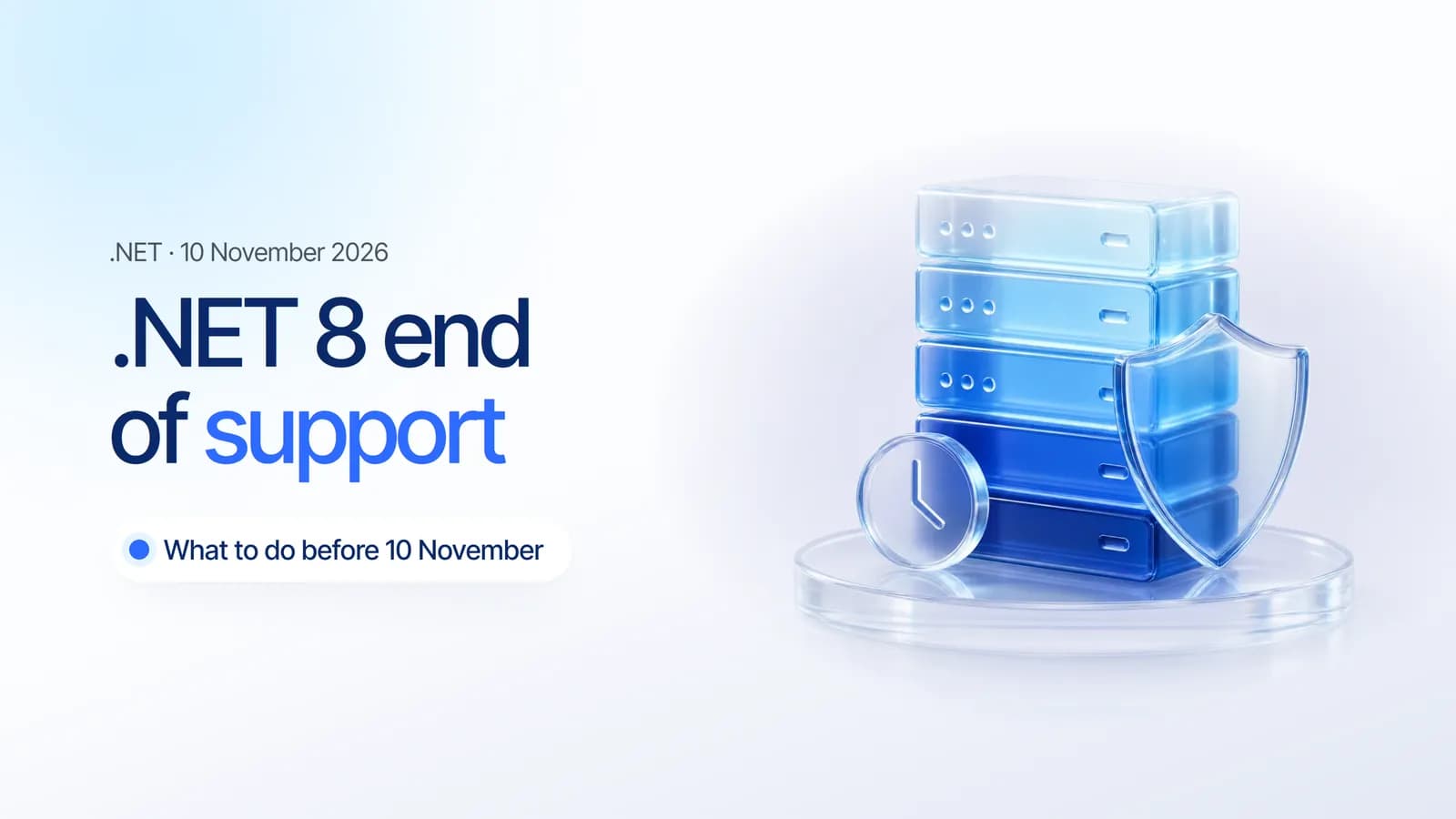
.NET 8 end of support arrives on 10 November 2026. On that date Microsoft also ends support for .NET 9, so two versions stop receiving security patches on the same Tuesday. Applications keep running, but new vulnerabilities are no longer fixed. If your business runs an API, a worker service, a desktop app or a container on .NET 8 or 9, the next two weeks are the time to plan the upgrade to .NET 10 LTS.
This article sums up the official dates, what the support policy says, how .NET 10 and the upcoming .NET 11 compare, and the six steps we use to upgrade client applications.
What ends on 10 November 2026
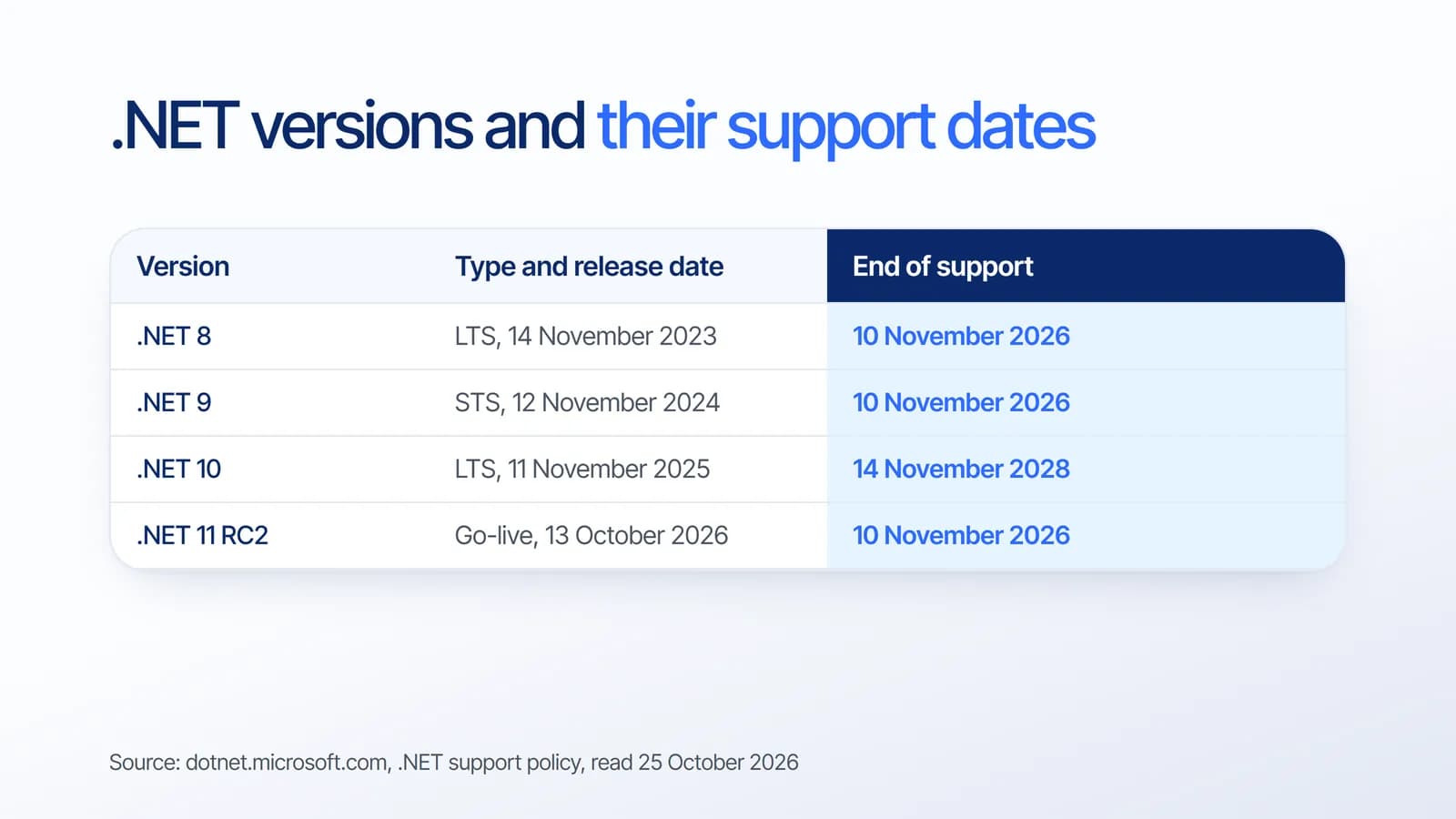
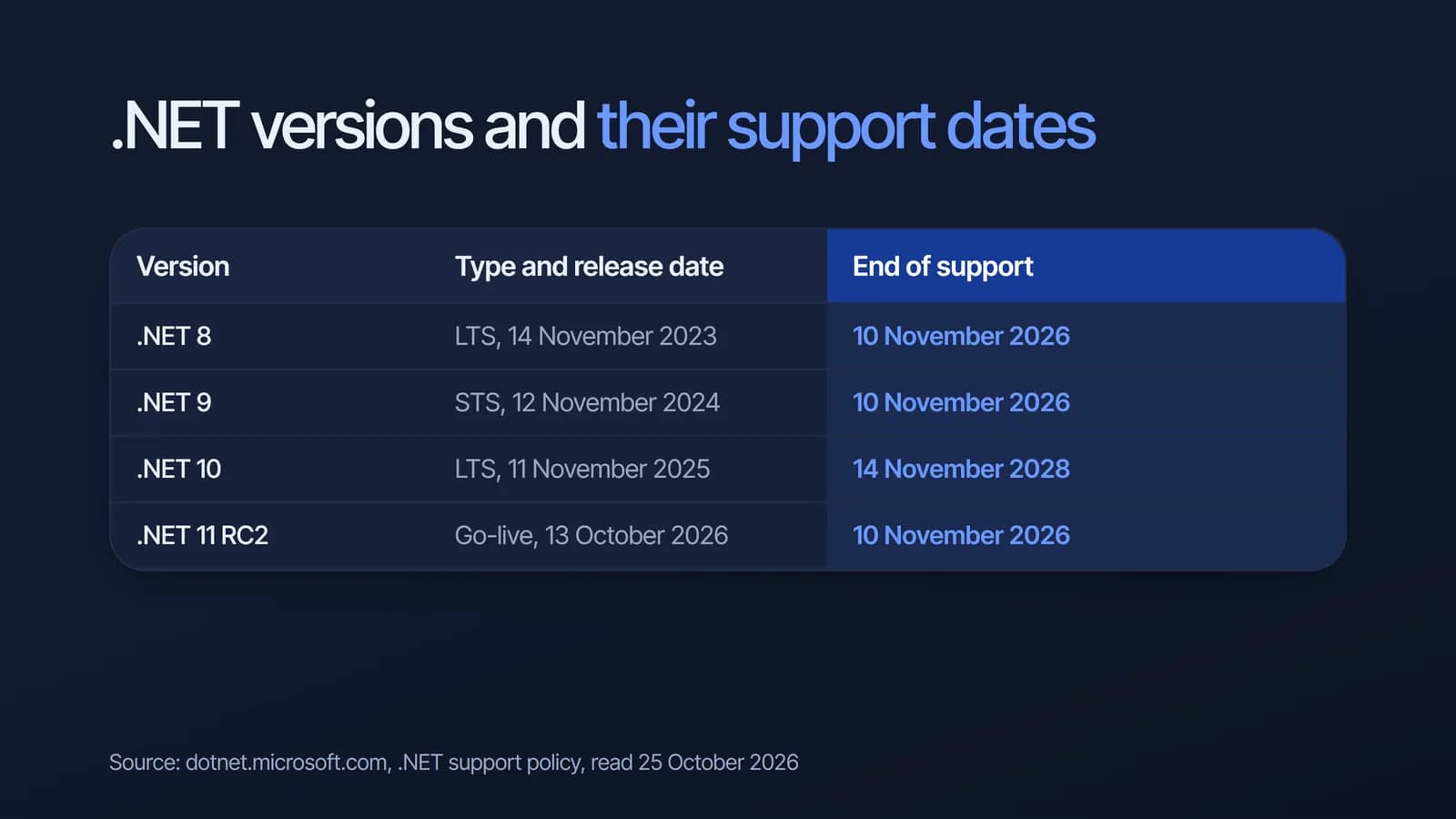
According to Microsoft’s .NET support policy, read on 25 October 2026:
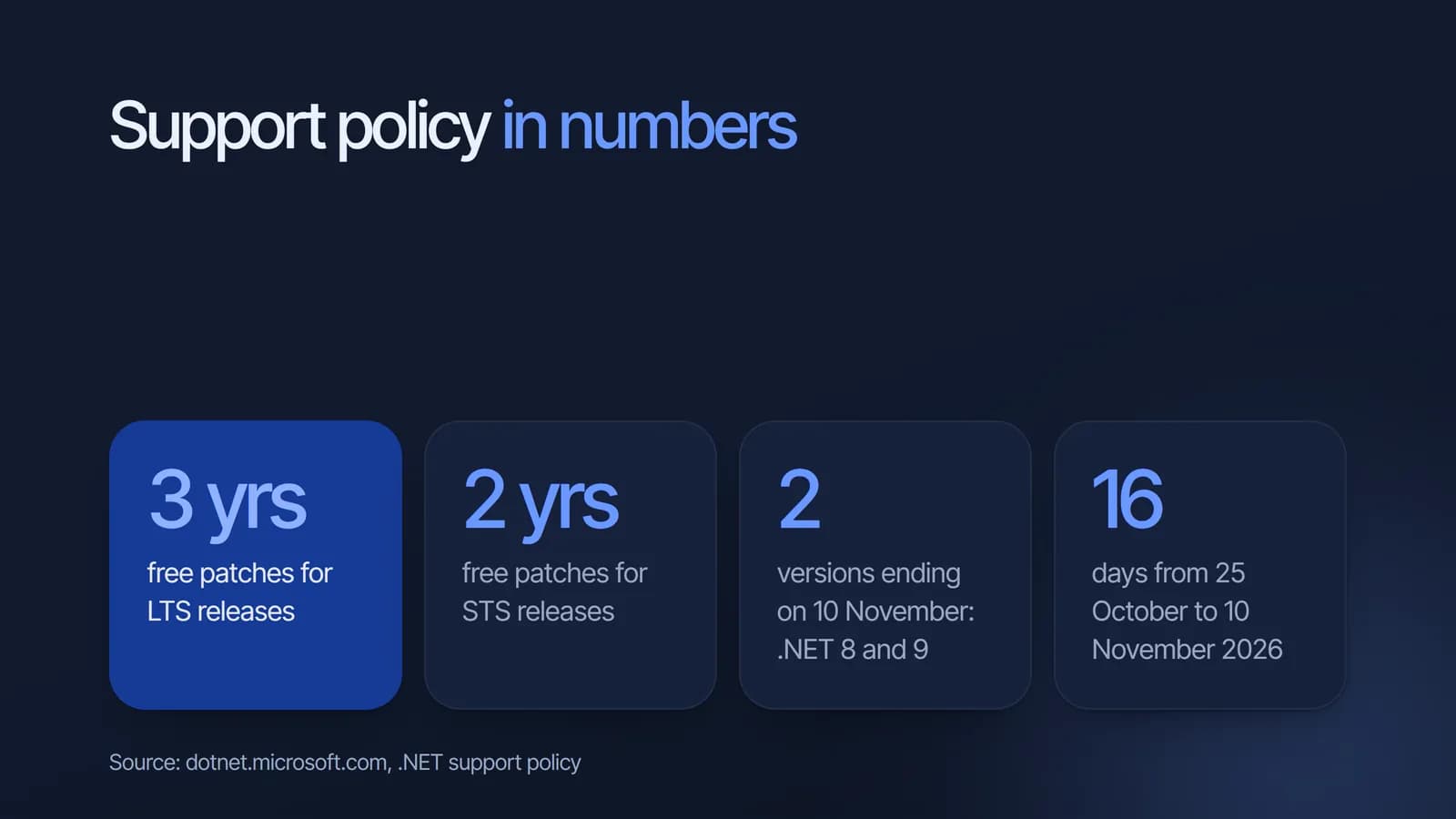
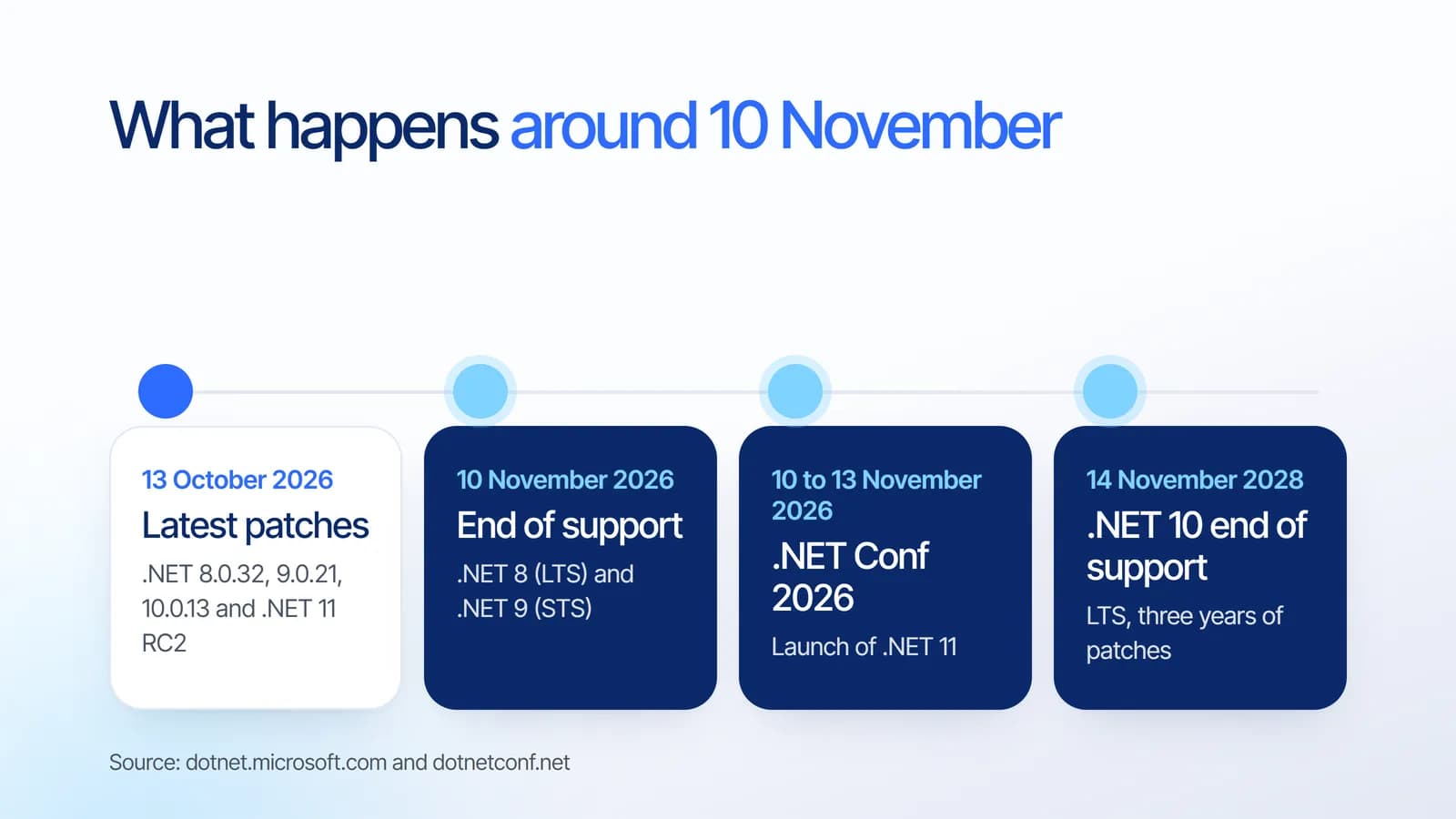
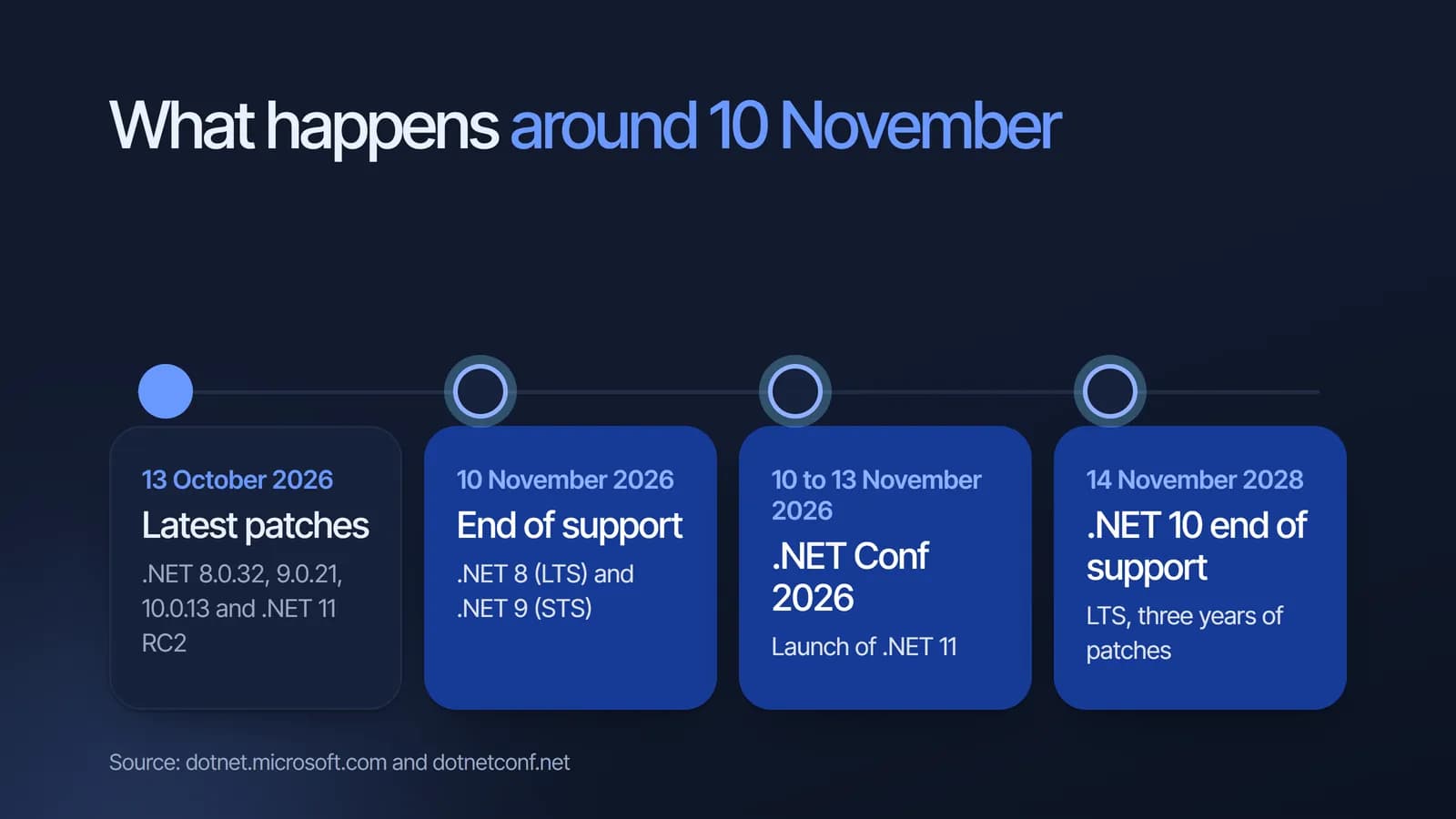
- .NET 8 is a Long Term Support (LTS) release from 14 November 2023. Its latest patch is 8.0.32 from 13 October 2026, and support ends on 10 November 2026.
- .NET 9 is a Standard Term Support (STS) release from 12 November 2024. Its latest patch is 9.0.21, and support also ends on 10 November 2026.
- .NET 10 is an LTS release from 11 November 2025, currently in active support, with patch 10.0.13 from 13 October 2026. Support ends on 14 November 2028.
- .NET 11 RC2 was released on 13 October 2026 as a go-live build, which Microsoft supports in production. Its support ends on 10 November 2026, when the final release is expected.
Why the .NET 8 end of support matters for a business application
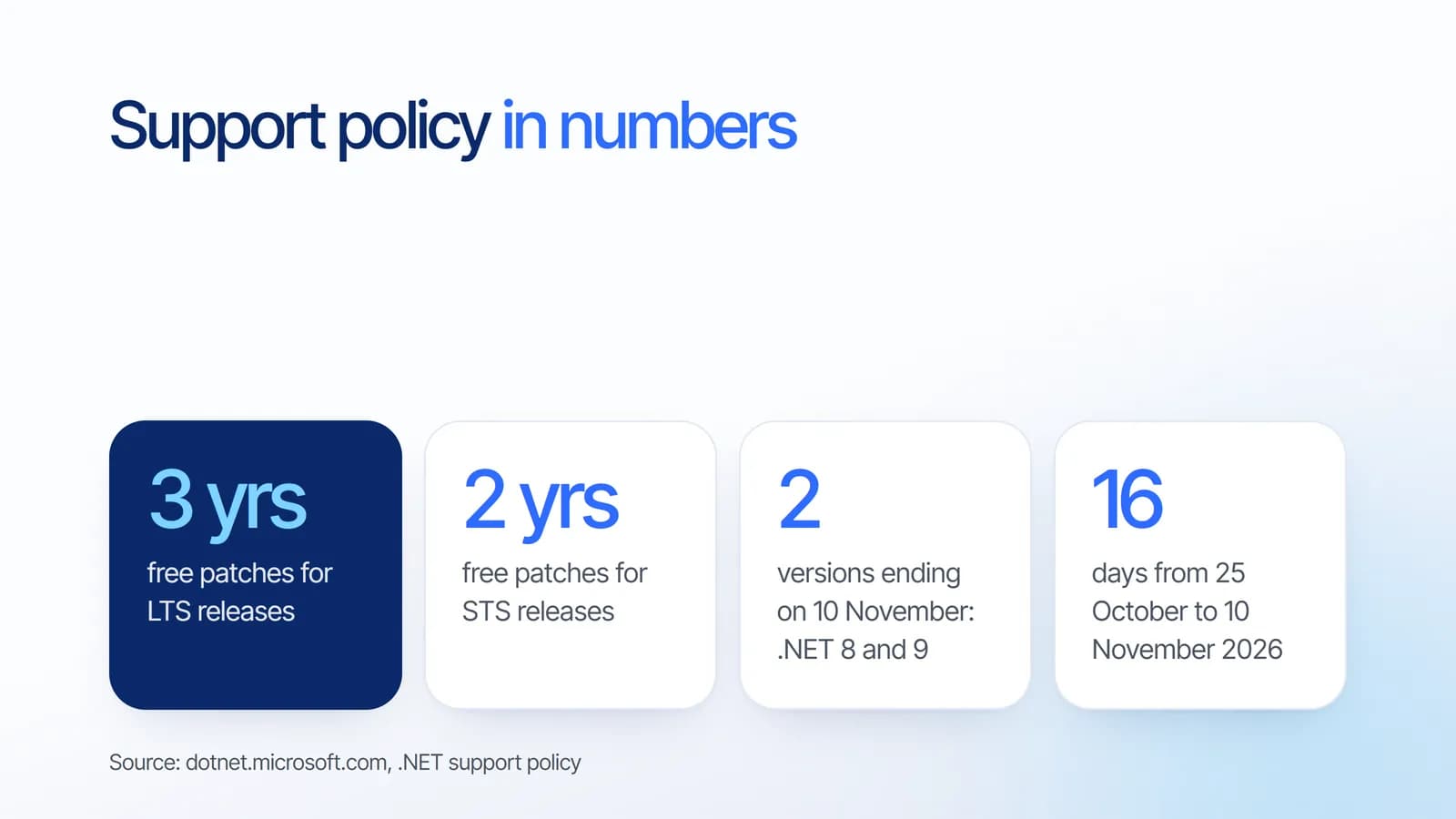
Microsoft’s policy is short and clear: LTS releases get free support and patches for three years, STS releases for two years. The quality of all releases is the same; the only difference is the length of support. The policy also says that systems must remain current on released patch updates to stay supported.
After 10 November 2026 there will be no more .NET 8 or .NET 9 patches, including security fixes. A web API that handles customer data, an internal dashboard, or a point-of-sale app on .NET 8 will keep working, but every vulnerability found afterwards stays open. Security and compliance checks increasingly flag unsupported runtimes, and some hosting and cloud platforms stop offering unsupported versions.
.NET 10 or .NET 11: which version to target
Microsoft launches .NET 11 at .NET Conf 2026, held online from 10 to 13 November. The second release candidate shipped on 12 October 2026 with a go-live licence, so teams can already run it in production. .NET 10, released a year earlier, is the current LTS version and is supported until 14 November 2028.
Our suggestion for most business applications is .NET 10 LTS. It gives the longest known support window, it has had a year of monthly patches, and the libraries you depend on already support it. Moving to .NET 11 on launch week is fine for teams that upgrade every year; check its support type on the policy page once it is listed there.
How to upgrade from .NET 8 to .NET 10 in six steps
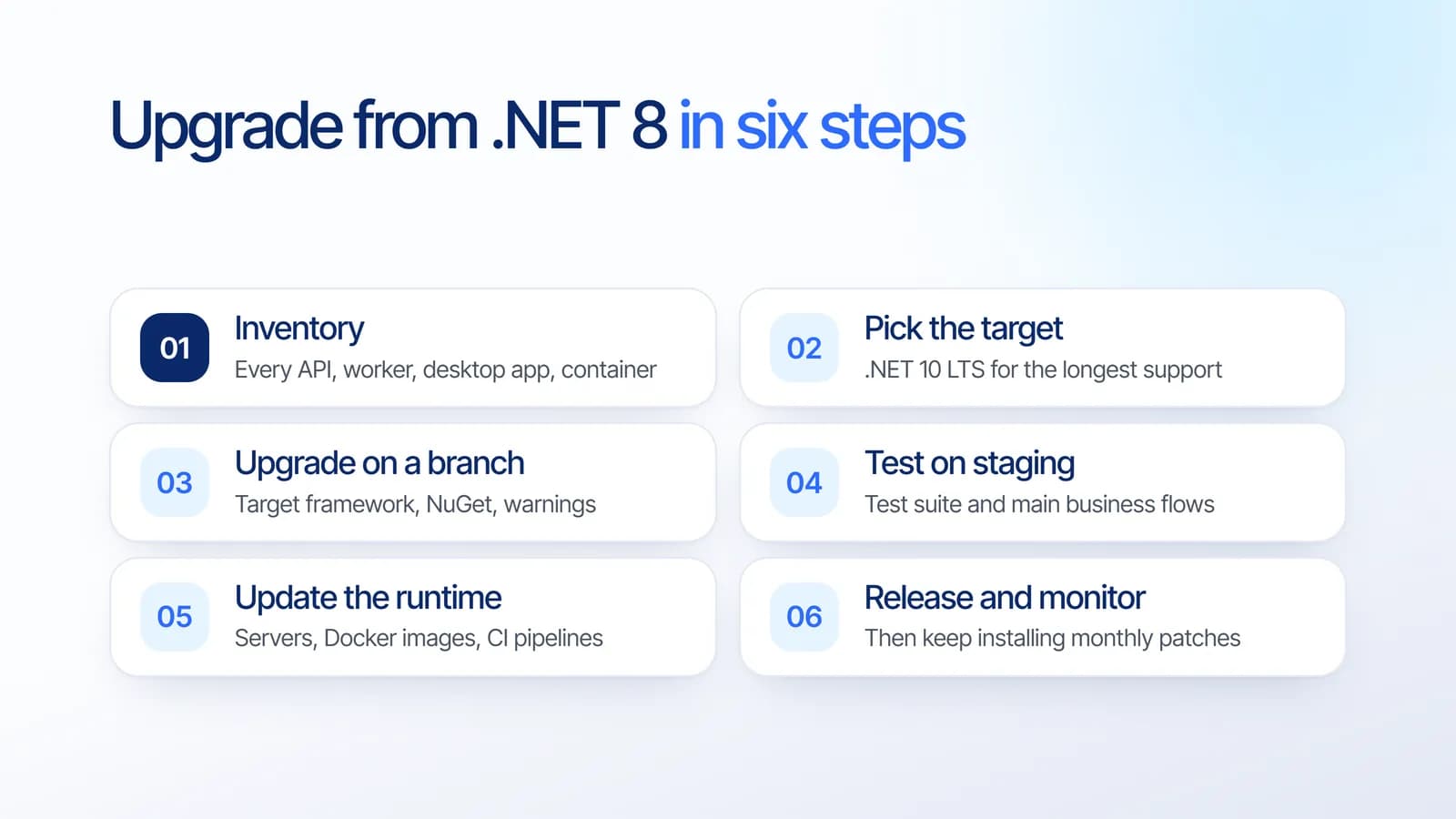
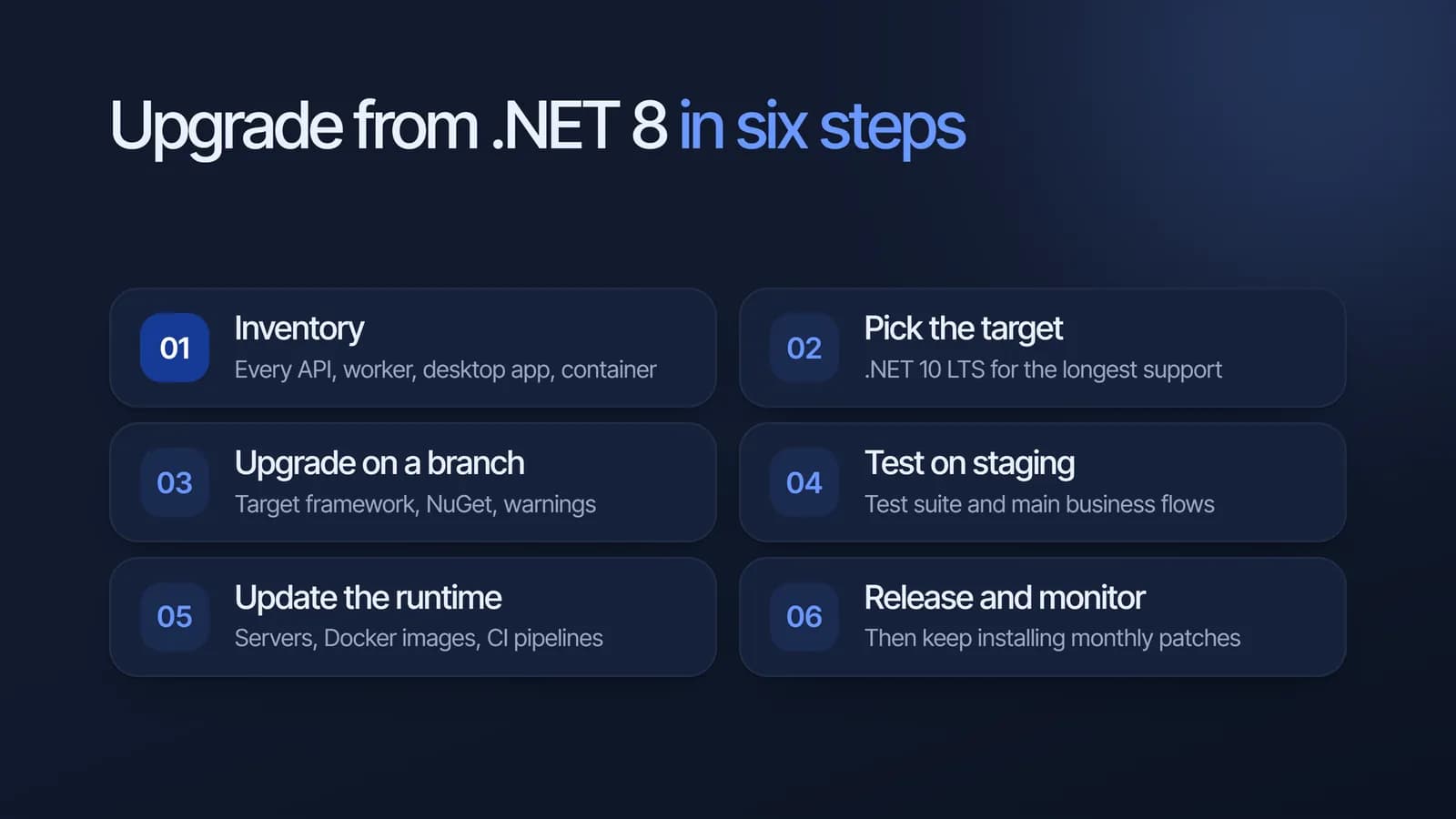
- Inventory every application. List each API, worker, desktop app and container with its target framework. Do not forget scheduled jobs and small internal tools; they are the ones usually left behind.
- Pick the target version. For business applications we suggest .NET 10 LTS. Check that your main NuGet packages, such as Entity Framework Core and any reporting or PDF libraries, have a version for it.
- Upgrade on a branch. Change the target framework to net10.0, update NuGet packages, build, and work through the warnings and breaking changes one project at a time.
- Test on staging. Run the test suite, then the main business flows by hand: login, checkout, reports, scheduled jobs, integrations with third parties.
- Update the runtime everywhere. Servers, Docker base images, CI pipelines and developer machines all need the .NET 10 SDK or runtime. A mismatch here is the most common reason an upgrade fails after it passed on a laptop.
- Release and keep patching. Deploy, watch logs and error rates for a few days, and keep installing the monthly patch releases, since the support policy requires staying current.
If you cannot finish before 10 November
Install the last .NET 8 or .NET 9 patches that are released, reduce exposure of the affected services (for example by keeping them behind a VPN or a WAF), and put the upgrade at the top of the list for November. Running a few weeks on an unsupported runtime is a known risk that you can manage; running a year on one is not.
What it means for your business
Many Indonesian companies run line-of-business systems on .NET: inventory, HR, finance, point of sale, and the APIs behind mobile apps. These systems often work quietly for years, which is exactly why they miss an end of support date. The date is fixed and public, so this is a planning problem, not an emergency, as long as the work starts now.
We saw a similar pattern earlier this month with the PHP security update: teams that already had staging, backups and a tested update routine finished in a day. The .NET upgrade is a good moment to put that routine in place.
How Estontinc helps
Estontinc is a software house in Malang, Indonesia, with 100+ projects and 50+ clients over more than six years. For .NET applications we can:
- Audit your .NET versions across every server, container and pipeline, and deliver a prioritised list before 10 November.
- Upgrade and test the applications on staging first, then production, as part of our custom software service.
- Update the infrastructure with our cloud and DevOps team: Docker images, CI/CD pipelines and monitoring.
- Keep it maintained after release with bug fixes, updates, monitoring and backups.
We work under NDA, you own the source code, and we communicate in English, Indonesian or Japanese. Want a quick check of your .NET estate before 10 November? Send the list through the contact page and we will reply within 24 hours.
Frequently asked questions
When does .NET 8 end of support happen?
Microsoft’s .NET support policy lists 10 November 2026 as the end of support for .NET 8, a Long Term Support release from 14 November 2023. Its latest patch is 8.0.32 from 13 October 2026. After 10 November, .NET 8 receives no further updates, including security fixes.
Does .NET 9 end of support happen on the same day?
Yes. .NET 9 is a Standard Term Support release from 12 November 2024, and the policy page lists 10 November 2026 as its end of support, the same date as .NET 8. STS releases get two years of free patches, LTS releases three years, so both versions end in the same month.
Should I upgrade to .NET 10 or wait for .NET 11?
For most business applications we suggest .NET 10 LTS, which is supported until 14 November 2028 and has had a year of monthly patches. .NET 11 launches at .NET Conf 2026 from 10 to 13 November, and its RC2 build from 13 October already has a go-live licence for production use.
What happens if I keep running .NET 8 after 10 November 2026?
The application keeps running, but Microsoft no longer releases patches for it, so any vulnerability found afterwards stays open. Microsoft’s policy also requires systems to stay current on patches to remain supported. Security audits and some hosting platforms flag or drop unsupported runtimes.
How long does an upgrade from .NET 8 to .NET 10 take?
It depends on the number of projects and third-party packages. A typical web API or worker service upgrades in days: change the target framework, update NuGet packages, fix warnings, test on staging, and update the runtime on servers and pipelines. Legacy dependencies and custom reporting libraries take the most time.
Sources
Facts and figures in this article come from these official sources.
- Security
- Maintenance
- .NET
- Custom software
- Cloud